


21 May Selling Properties Across Borders: How Visualization Powers Cross-Border Real Estate in Japan
The Cross-Border Real Estate Boom in Numbers
Japan’s property market has become one of the most active cross-border investment arenas in Asia-Pacific—and the numbers make clear why visualization has moved from a marketing extra to deal-critical infrastructure.
Foreign acquisition of Japanese real estate hit ¥939.7 billion in 2024, a 63% year-over-year surge driven by persistent yen weakness, relatively low interest rates, and strong institutional demand from North American and Asian funds. On the commercial side, total investment volume reached ¥4.66 trillion—a ten-year high—with the foreign share of Q4 transactions tripling compared to the prior year. Marquee deals like Blackstone’s roughly ¥400 billion acquisition of Tokyo Garden Terrace Kioicho underscored the scale of offshore appetite.
The flow is not one-directional. Japanese developers have been aggressively expanding outbound, with overseas real estate investment stock reaching ¥26.7 trillion (+19% year-over-year). Nomura Real Estate, Mitsubishi Estate, and Hankyu Hanshin are all deploying billions into Southeast Asian and European markets, creating parallel demand for visualization assets that speak to local buyers in local languages.
At the residential end of the spectrum, the Ministry of Land, Infrastructure, Transport and Tourism’s first-ever survey of foreign purchasers revealed that overseas residents accounted for 7.5% of new condominium purchases in Tokyo’s six central wards during the first half of 2025—double the rate from the previous year. Taiwan-based buyers led the count, followed by purchasers from mainland China and Singapore.
These figures point to one structural reality: a growing share of Japan’s real estate transactions now involves at least one party that cannot easily visit the property in person. That gap between buyer and building is exactly where cross-border real estate visualization in Japan earns its return.
Why Remote Buyers Need More Than Floor Plans
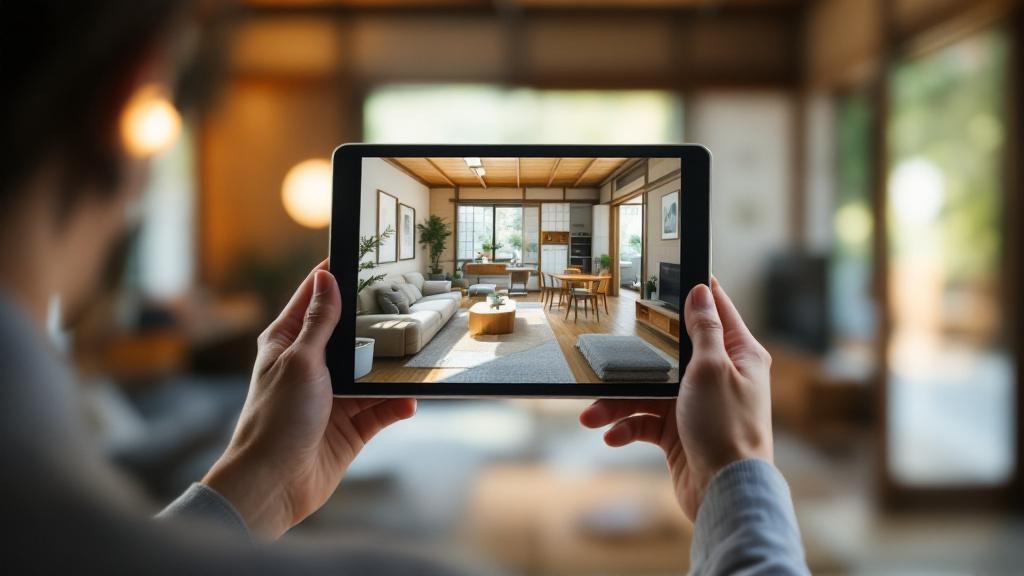
Distance is not a new problem in real estate. What has changed is the evidence base proving that immersive visualization directly accelerates transactions—and the speed at which remote viewing tools have moved from novelty to norm.
A 2023 survey reported by PR Newswire found that 89% of Chinese investors expressed interest in online property tours of Japanese assets. Given that Greater China buyers represent the single largest foreign purchaser cohort in Tokyo’s residential market, this statistic alone signals how critical virtual tour capability has become for selling Japanese real estate to overseas buyers.
Academic evidence reinforces the commercial signal. Researchers at UT Dallas analyzed roughly 43,000 transactions on China’s largest property platform and found that VR tours accelerated sales by an average of 44%—cutting median days-on-market from 34 to 19—without altering sale prices. The mechanism was not emotional persuasion but information transparency: VR reduced the asymmetry between what the seller knew and what the buyer could verify remotely, enabling faster commitment.
Major commercial operators have already internalized this logic. Cushman & Wakefield Japan deployed Matterport 3D scanning across all of its commercial holdings, treating virtual tours not as a pandemic stopgap but as permanent infrastructure for property management and investor engagement. The firm reported engagement rates over 300% higher than conventional 2D listing imagery.
Domestically, IT-based remote viewings are no longer niche. According to the Real Estate Information Site Council’s 2025 survey, 37.4% of Tokyo-area tenants used some form of online viewing in 2024—the highest figure since tracking began—while intent to use online contract execution hit 42.2%, a three-year consecutive increase. For foreign investors evaluating assets from Taipei, Singapore, or San Francisco, the expectations are even higher. A virtual tour for foreign property investors is table stakes, not a differentiator.
| Metric | Value | Source |
|---|---|---|
| Chinese investors interested in online tours of JP property | 89% | PR Newswire 2023 |
| Sales acceleration from VR tours (UT Dallas study) | 44% (34 → 19 days) | *Information Systems Research* |
| Engagement lift from Matterport 3D vs. 2D images | 300%+ | Cushman & Wakefield Japan |
| Tokyo-area tenants using online viewings (2024) | 37.4% | RSC 2025 survey |
Inbound Use Case: Foreign Investors Buying Japanese Property
When a foreign buyer evaluates a Japanese property from abroad, they face a compounding set of barriers that static floor plans cannot address.
Language Multiplied by Distance
The language barrier is the most obvious hurdle, but it is not simply about translation. Visualization materials need to communicate spatial relationships, neighborhood context, and regulatory information in ways that make sense to buyers operating in different cultural frameworks. Multilingual visualization—3D walkthroughs with English, Chinese, or Vietnamese overlays—gives foreign buyers the spatial literacy they need without requiring a bilingual agent to be available in every time zone. LIFULL HOME’S recognized this demand when it launched its FRIENDLY DOOR portal in 2024, enabling foreign buyers to search for multilingual-capable agents—but the need extends upstream to every piece of marketing collateral the buyer encounters.
Regulatory Complexity Demands Visual Context
Japan’s building standards, seismic certification requirements, and foreign ownership rules introduce legal complexity that text alone cannot clarify. Showing a buyer how earthquake-resistant construction translates into structural design, or how floor-area ratio regulations shape a building’s envelope relative to its neighbors, requires three-dimensional context. Visualization transforms abstract regulatory constraints into spatial understanding—critical for a buyer committing hundreds of millions of yen from overseas.
A Typical Inbound Pattern
Consider the transaction pattern now common in Tokyo’s Minato-ku: a Taiwan-based investor evaluates a high-floor condominium unit. The agent provides a 3D walkthrough of the unit interior, a drone-captured neighborhood fly-over showing proximity to transit, parks, and commercial amenities, and a photorealistic exterior rendering that communicates the building’s presence on the streetscape. The investor shortlists the property without a site visit, flies in only for final due diligence, and closes within weeks of first contact. This pattern—screen first, plane second—is now the dominant workflow for cross-border residential transactions in central Tokyo.
Outbound Use Case: Japanese Developers Marketing Overseas
The visualization imperative runs in both directions. Japanese developers expanding into Southeast Asia and Europe face mirror-image challenges: selling to local buyers who cannot visit a Tokyo headquarters showroom and who expect marketing materials in their own language.
Nomura Real Estate in Vietnam
Nomura Real Estate has developed over 26,000 condominium units across Ho Chi Minh City, Hanoi, and Haiphong. Marketing properties at this scale to Vietnamese buyers demands CG renders and VR assets produced in Vietnamese, calibrated to local aesthetic expectations, and distributed through local digital channels. The sheer volume—comparable to a mid-sized Japanese city’s annual housing starts—makes real estate marketing for inbound investment japan a mirror of the outbound challenge: different geography, identical visualization need.
Hankyu Hanshin and ROOV in the Philippines
Hankyu Hanshin Properties adopted the ROOV 3D sales platform for its Philippine joint venture in 2024—the first overseas deployment of a Japanese-developed 3D residential sales tool. ROOV allows prospective buyers to explore unbuilt units through interactive browser-based walkthroughs, eliminating the need for physical showroom infrastructure in early-stage marketing. The case illustrates how Japanese visualization technology itself is becoming an export product, not merely a support function.
Mitsubishi Estate in London
Mitsubishi Estate’s £1.6 billion “72 Upper Ground” development on London’s South Bank—the company’s largest-ever overseas project—requires multilingual CG content addressing both UK-based buyers and Japanese institutional investors tracking the asset. The visualization package must serve dual audiences in dual languages, with rendering quality calibrated to London’s luxury property marketing standards. For a mid-sized bilingual visualization partner, this type of engagement represents exactly the service gap where architectural and real estate visualization for cross-border projects delivers the most value.
| Developer | Market | Scale | Visualization approach |
|---|---|---|---|
| Nomura Real Estate | Vietnam | 26,000+ condo units | CG/VR in Vietnamese for local buyers |
| Hankyu Hanshin | Philippines | JV residential | ROOV 3D platform (first overseas deployment) |
| Mitsubishi Estate | London | £1.6B mixed-use | Multilingual CG for UK + Japanese audiences |
Building a Visualization Strategy for Cross-Border Deals
Whether you are marketing a Shibuya office tower to a Singapore REIT or selling Thai resort villas to Japanese retirees, the visualization strategy follows a consistent three-step framework.
Step 1 — Identify Buyer Geography and Language Requirements Before Production
The costliest mistake in cross-border visualization is producing beautiful assets in the wrong language—or in a format that does not travel well across the buyer’s preferred channels. Before commissioning any renders or tours, map your buyer universe by geography and language. A Minato-ku luxury condo targeting Taiwanese and Singaporean buyers needs English and Traditional Chinese overlays. A Vietnamese residential development targeting local first-time buyers needs Vietnamese-language walkthroughs optimized for mobile delivery. Define these parameters before a single camera angle is set.
Step 2 — Choose Format by Distance and Deal Stage

Not every buyer needs the same asset at every stage of the funnel. A practical format selection matrix:
| Deal stage | Buyer distance | Recommended format | Purpose |
|---|---|---|---|
| Awareness | Any | Photorealistic still renders | Capture attention on listing portals and social media |
| Consideration | Remote (no site visit planned) | Interactive virtual tour / 3D walkthrough | Enable spatial evaluation without travel |
| Shortlist | Remote or pre-visit | VR walkthrough + drone neighborhood footage | Provide site context and surroundings |
| Due diligence | On-site or hybrid | Cinematic video + drone aerials | Confirm expectations, support final approval |
Still renders cost a fraction of full VR production and serve well for top-of-funnel awareness campaigns. Reserve immersive formats—interactive 3D tours, VR experiences, drone fly-overs—for prospects who have moved past initial interest and need spatial confidence before committing to a site visit or an offer.
Step 3 — Partner with a Bilingual Vendor Who Understands Both Sides
Cross-border visualization is not a pure creative exercise. The vendor producing your 3D walkthrough needs to understand Japanese building standards well enough to represent seismic bracing accurately, and international buyer expectations well enough to know that a Singaporean investor wants to see the view from the 30th floor, not just the lobby. A domestic Japanese CGI studio may nail the technical accuracy but struggle with English-language overlays. An offshore rendering house may deliver photorealistic stills but miss the regulatory context that makes a visualization trustworthy to a compliance-conscious institutional buyer.
The sweet spot is a bilingual production partner with feet in both worlds—capable of producing DMPJ’s bilingual visualization services that combine Japanese architectural precision with international marketing sensibility. That combination is rare, which is precisely why it commands a premium and why it converts.
Cross-border real estate transactions live or die on the buyer’s ability to evaluate a property remotely. DMPJ’s bilingual team produces 3D renders, virtual tours, drone footage, and cinematic video that bridge the distance gap for inbound and outbound deals. Learn more on our architectural and real estate visualization page.
Sorry, the comment form is closed at this time.