

28 May What Is Japanese Business Etiquette Training? A Primer for International Teams
Most international professionals arriving in Japan know to bow and hand over a business card with both hands. That surface-level awareness lasts about ten minutes into the first real meeting — the point where silence falls, nobody objects, and you assume everyone agrees. They probably don’t. The distance between tourist-grade etiquette and operational cultural fluency is where deals stall, partnerships unravel, and expensive expatriate assignments end early. This primer explains what Japanese business etiquette training actually is, what it covers, who benefits from it, and why it has become a strategic investment rather than a courtesy checkbox.
Why Japanese Business Culture Stands Apart
Japan’s business environment is routinely identified as one of the most culturally distinct for Western professionals. The EU-Japan Centre for Industrial Cooperation describes Japan’s ritualized business culture as “often considered the biggest obstacle for foreign businesses” seeking to establish operations there. That assessment is backed by market behavior: the global cross-cultural training market reached $2.39 billion in 2025 and is projected to grow at 6.7% CAGR through 2033, with Japan-specific training commanding a 15–30% premium over generic intercultural programs because the expertise required is deeper and the trainer pool smaller.
Beyond Bowing and Business Cards
The gap that catches most teams off guard sits between visible protocols and invisible operating systems. Visible protocols — bowing depth, card exchange sequence, seating arrangements — can be memorized from a guidebook. The invisible systems cannot. *Nemawashi* (pre-meeting consensus building) means that by the time a formal meeting occurs, the decision has often already been made through behind-the-scenes alignment. *Honne* versus *tatemae* — the distinction between a person’s genuine feelings and their public-facing position — governs how feedback is delivered, objections are raised, and interest is expressed. An international team that misreads polite interest (*tatemae*) as genuine enthusiasm (*honne*) can invest months pursuing a partnership that was never going to materialize.
The Real Cost of Cultural Missteps
The financial consequences are tangible. Industry estimates suggest that a significant majority of international business setbacks involving Japanese partners trace back to cultural misunderstanding rather than commercial or technical factors. On the personnel side, Japan’s average employee retention rate sits at 84.6%, but foreign staff without adequate cultural preparation frequently leave within the first 18 months — turning relocation investments of $150,000–$300,000 per assignment into write-offs. Deals don’t explode; they go quiet. Partnerships don’t collapse; they simply stop progressing. The absence of direct confrontation in Japanese business culture means the damage is often well advanced before international teams realize something has gone wrong.
What Japanese Business Etiquette Training Actually Covers
So what is Japanese business etiquette training in practical terms? It is structured preparation that moves professionals from awareness of Japanese customs to fluency in applying them under real business pressure. Quality programs cover four interconnected domains.
Business Card Exchange and Greeting Protocols
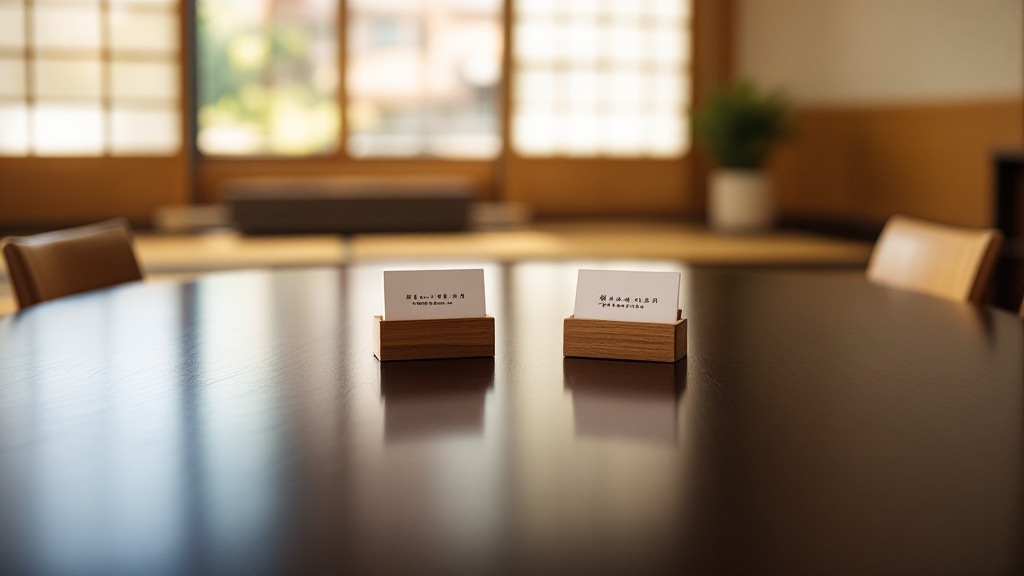
*Meishi koukan* (business card exchange) is not a formality — it is the opening act of trust-building. As outlined in Shinka Management’s guide to Japanese business etiquette, cards are presented with both hands, received with visible attention, and studied before being placed carefully on the table during the meeting. Writing on someone’s card, pocketing it casually, or — worst of all — forgetting to bring cards signals that you have not taken the relationship seriously before it begins. Training programs use role-playing to build muscle memory for these exchanges so they feel natural rather than rehearsed.
Meeting Hierarchy and Conference Room Dynamics

Japanese conference rooms operate on an unspoken spatial hierarchy. The seat farthest from the door (*kamiza*) belongs to the most senior person. Juniors sit closest to the exit. Presenters are expected to address the senior decision-maker even when questions come from others. Training covers these positioning norms along with the rhythm of Japanese meetings: extensive note-taking as a sign of respect, minimal interruption, and the expectation that decisions will be formalized *after* the meeting through internal consultation rather than decided on the spot.
Indirect Communication and the Weight of Silence
Silence in a Japanese meeting is not a breakdown — it is processing time. Hedging language such as “that might be difficult” almost always means no. Explicit rejection is rare and considered unnecessarily blunt. Training in indirect communication teaches participants how to decode these signals: reading body language, interpreting qualified statements, and recognizing that enthusiasm is typically expressed through action rather than verbal affirmation. According to Commisceo Global’s analysis of Japanese negotiation style, three pillars — sincerity, compatibility, and trust — form the foundation of Japanese business relationships, and each is evaluated primarily through observed behavior rather than stated intent.
Dining, Gift-Giving, and After-Hours Relationship Building

Business dinners, *nomikai* (drinking gatherings), and gift exchange are not social extras in Japan — they are relationship infrastructure. Training covers practical specifics: pouring etiquette (never fill your own glass), appropriate gift wrapping and presentation, seasonal gift-giving cycles (*ochugen* in summer, *oseibo* in winter), and the strategic importance of after-hours socializing as a space where more candid conversation becomes possible outside the constraints of *tatemae*.
Who Needs This Training (and When)
Japanese business culture training for international teams is not limited to one profile. Four distinct audiences benefit from structured preparation, each with different needs and timelines.
Foreign companies entering Japan. Sales teams, country managers, and partnership leads need front-line cultural fluency before engaging Japanese counterparts. JETRO actively supports international companies entering Japan with market intelligence and introductions, but the cultural preparation that turns those introductions into productive relationships requires dedicated training.
Japanese companies expanding overseas. Staff responsible for managing foreign partners or explaining Japanese expectations to international counterparts need training in the *other* direction — understanding how their own business culture reads from the outside and learning to bridge the gap without abandoning the practices that make Japanese business relationships effective.
Expatriates and their families. Relocation involves not just the employee but the household. Spouses navigating daily life, school enrollment, and neighborhood relationships face cultural adaptation challenges that directly affect the employee’s focus and longevity in the role.
Timing. Pre-departure training is the ideal window — it builds confidence before first contact. But post-arrival “rescue” training is equally common and often more urgent, typically triggered when early interactions have already created confusion or friction.
How Training Is Typically Delivered
Japan’s soft skills training market reached $2.2 billion in 2025 and is growing at 10.55% CAGR, driven partly by the expansion of flexible delivery formats that make cross-cultural etiquette training Japan-accessible to teams of any size and location.
| Format | Best For | Typical Duration | Key Advantage |
|---|---|---|---|
| **In-person workshops** | Pre-departure teams, executive groups | 1–2 days | Role-playing with live feedback and real-time scenario practice |
| **Virtual sessions** | Distributed teams across time zones | 2–4 hours per session | Accessible without travel; can be scheduled around operational demands |
| **Hybrid programs** | Ongoing development over weeks or months | Self-paced modules + live coaching | Combines knowledge acquisition with practiced application |
| **Industry-specific modules** | Tech, finance, hospitality, government | Varies | Content tailored to sector norms (e.g., regulatory meetings vs. client entertainment) |
In-person workshops remain the standard for high-stakes preparation — negotiation teams, C-suite visitors, and newly appointed country managers. Virtual delivery has expanded considerably since 2020 and now serves distributed teams effectively, particularly for foundational modules. Hybrid approaches that pair self-paced e-learning with periodic live coaching sessions offer the strongest balance of scalability and depth. The most effective programs also include industry-specific modules, because business etiquette in a Japanese government ministry differs meaningfully from protocols at a Tokyo fintech startup. DMPJ’s Japanese business etiquette programs offer all four formats, adapting the mix to the client’s industry, team structure, and timeline.
Common Misconceptions That Hold Companies Back
Several persistent myths prevent organizations from investing in cultural preparation — or lead them to invest poorly.
| Misconception | Reality |
|---|---|
| **Language fluency equals cultural fluency** | A team member fluent in Japanese can still misread consensus signals, violate hierarchy norms, or misinterpret silence. Linguistic competence and cultural competence are separate skill sets. |
| **A one-hour webinar is sufficient** | Companies that invest [$1,500+ per employee annually](https://www.devlinpeck.com/content/employee-training-statistics) in training see 24% higher profit margins than those spending less. A one-hour overview creates awareness without building applicable skills. |
| **Younger Japanese professionals have abandoned traditional etiquette** | While workplace formality has relaxed in some startup environments, the vast majority of Japanese companies — especially established firms and government entities — still operate on traditional protocols. Assuming otherwise is a high-risk bet. |
| **Only client-facing staff need cultural preparation** | Back-office teams writing emails, operations staff coordinating logistics, and finance personnel negotiating payment terms all create cultural impressions. A tone-deaf email from an internal team member can undo weeks of careful relationship building by the sales lead. |
These misconceptions share a common root: underestimating the depth at which culture operates in Japanese business. As Japan Intercultural Consulting notes in their work on cross-cultural fitness, effective cultural adaptation requires a healthy organizational environment where differences are understood — not just a few individuals who have read a briefing document.
What Happens Without Training — Three Warning Patterns
When teams enter Japanese business relationships without structured cultural preparation, the breakdowns follow predictable patterns. These are not hypothetical — they are composites drawn from documented training provider case studies and industry research.
Pattern 1 — The Meeting That Went Silent
A European technology firm presents its platform to a group of Japanese manufacturing executives. The presentation goes well — polite attention, extensive note-taking, no objections. The European team leaves confident. Weeks pass with no follow-up. What happened? The silence during the meeting was not agreement — it was the Japanese team’s standard practice of listening fully before consulting internally. The Europeans interpreted absence of objection as consensus and stopped pushing. The Japanese team interpreted the Europeans’ lack of follow-up as disinterest. Both sides waited. The deal died of mutual misunderstanding.
This pattern — misreading consensus signals — is one of the most common failure modes. Training addresses it by teaching participants to recognize that Japanese meetings are information-gathering events, not decision-making ones, and that persistent, respectful follow-up is expected rather than presumptuous.
Pattern 2 — The Deal That Died by Email
A U.S. services company negotiating contract terms with a Tokyo-based partner sends a detailed email outlining concerns about pricing, timelines, and liability clauses. The tone is direct, efficient, and professional by American standards. The Japanese partner reads it as aggressive, confrontational, and lacking in respect for the relationship that both sides have spent months building. Replies become shorter. Meetings become harder to schedule. The partnership quietly dissolves.
Written communication is where cultural miscalibration causes the most undetected damage. Japanese business correspondence follows different tonal conventions — opening with seasonal greetings, acknowledging the relationship, framing concerns as shared problems rather than demands. Organizations that implemented targeted negotiation training have documented returns as high as $54 for every $1 invested, largely through improved deal outcomes that proper communication training enables.
Pattern 3 — The Expatriate Who Resigned at Month Six
A senior manager relocates to Tokyo with her family, confident in her professional skills. Six months in, she resigns. The surface reasons are workload and family adjustment, but the root cause is cultural isolation: exclusion from informal decision-making networks, inability to read team dynamics, and the exhaustion of operating without cultural context twelve hours a day. This pattern recurs across industries. One pharmaceutical joint venture documented expatriate turnover dropping from over 20% to 4–7% annually after implementing a six-month cultural training program, calling the training investment its most effective retention tool.
These three patterns share a common thread: the problem was not lack of competence but lack of cultural context. In each case, structured preparation before or shortly after engagement would have changed the outcome.
Getting Started: What to Look For in a Training Provider
For teams evaluating Japanese business culture training for international teams, several factors distinguish programs that create lasting capability from those that produce only temporary awareness:
- Bilingual depth. The provider should operate fluently in both English and Japanese — not just linguistically but culturally. Understanding how concepts translate between business cultures is the core skill.
- Customization to your industry. Generic “Japan 101” content has limited value. A fintech sales team and a hospitality management group face different cultural challenges and need different preparation.
- Practical application. Role-playing, scenario practice, and real-world case analysis build applicable skills. Lecture-only formats do not.
- Flexible delivery. Your team’s schedule, location, and learning preferences should drive the format — not the provider’s convenience.
If your team is preparing to work with Japanese partners, clients, or colleagues, structured cultural preparation can mean the difference between a productive first year and a costly false start. DMPJ’s Cultural and Business Etiquette Training offers customized, bilingual workshops designed around your specific industry and business goals — delivered in-person, virtually, or as a hybrid program. Explore DMPJ’s etiquette training programs to see how hands-on cultural coaching can give your team a genuine advantage in the Japanese market.
Sorry, the comment form is closed at this time.