

22 Apr In-House vs. Outsourced Media Production in Japan: How to Make the Right Call
The Core Tension — Control vs. Flexibility
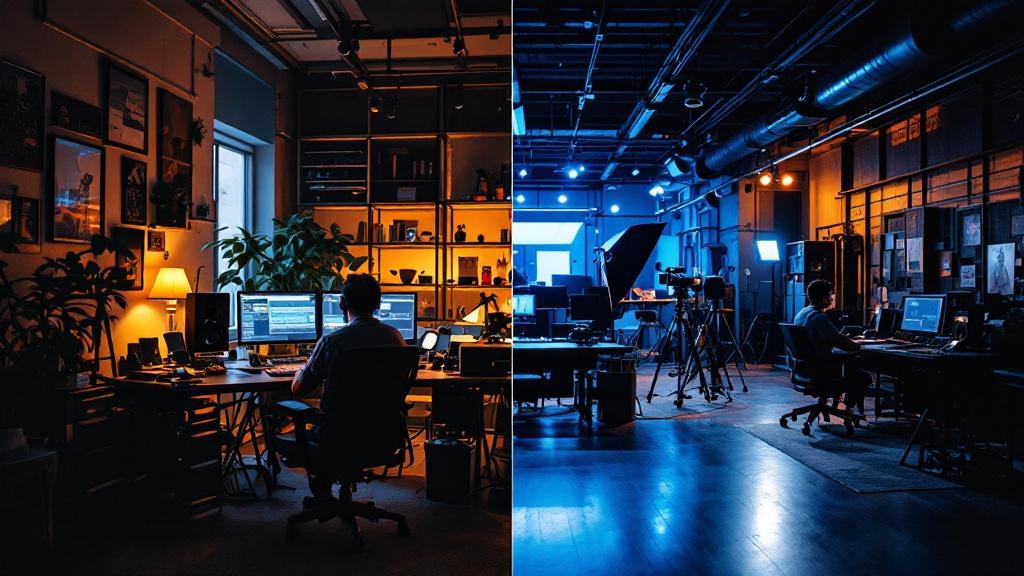
Every company operating in Japan eventually faces the same production question: should we build an internal team or bring in outside help?
Japan’s video production services market reached ¥4,238 billion in fiscal 2024, with projections pointing toward ¥5,400 billion by fiscal 2027. Meanwhile, total advertising expenditure hit a record ¥8,062.3 billion in 2025, with internet advertising crossing the 50% threshold for the first time. The demand for quality media production in Japan is undeniable — the question is how to meet it.
In-house teams offer direct quality control and intellectual property protection. When your production staff sits ten meters from your product team, feedback loops tighten, brand consistency improves, and sensitive material stays within your walls. For companies with confidential R&D cycles or tightly regulated industries, this control is not a luxury — it is a requirement.
Outsourcing provides the opposite advantage: specialist expertise and scalable capacity. A production consulting partner in Japan can assemble a crew for a ¥5 million campaign in weeks, then stand down when the project wraps. You pay for output, not overhead.
Here is the reality most successful SMEs discover: they end up with a hybrid model. The question is not whether to go fully in-house or fully outsourced. It is where to draw the line between the two. Getting that line wrong costs money, time, and competitive position. Getting it right creates a production capability that punches well above its weight.
This article gives you a concrete framework for making that call — with real cost data from the Japanese market, not abstract theory.
True Cost Comparison — Beyond Headcount

The in-house vs. outsourced media production decision in Japan often stalls because leaders compare the wrong numbers. Headcount cost versus project fees is a starting point, not the full picture. Both models carry hidden costs that only surface after commitment.
Direct Costs Side by Side
| Cost Category | In-House | Outsourced |
|---|---|---|
| Equipment (cameras, lighting, audio) | ¥500K–¥3M upfront investment | Included in project fee |
| Software licenses (editing, motion graphics) | ¥200K–¥800K/year | Included in project fee |
| Recruitment & onboarding | ¥500K–¥1.5M per hire (agency fees, training) | N/A |
| Per-project cost | Marginal once team is established | ¥500K–¥5M per engagement |
| Retainer/ongoing support | Staff salaries (¥4M–¥8M/year per person) | ¥300K–¥1.5M/month |
Sources: Equipment and project fee ranges from Yano Research Institute market data; per-project video costs based on industry production cost benchmarks.
Hidden Costs of In-House Production
The line items above tell only part of the story. Three hidden costs consistently catch companies off guard:
Underutilization during demand troughs. A two-person production team costs roughly ¥10–16 million per year in salaries alone. If your content calendar drops from twelve projects to four during a slow quarter, those salaries do not shrink. Companies maintaining in-house production absorb fixed costs regardless of output volume — a burden that hits SMEs disproportionately hard.
Single-point-of-failure risk. Japan’s labor market for experienced production professionals is tight. When your lead editor or camera operator leaves, you lose not just a role but institutional knowledge — the understanding of your brand voice, your approval workflows, your stakeholder preferences. Rebuilding that capability takes months, and production stalls in the interim.
Technology obsolescence. Equipment purchased today depreciates. Software platforms evolve. A ¥3 million camera investment amortized over five years locks you into a specific capability level while external vendors continuously refresh their gear.
Hidden Costs of Outsourcing
Outsourcing carries its own buried expenses:
Coordination overhead. Every external engagement requires briefing, feedback cycles, and quality review. Research on SME sourcing decisions consistently identifies coordination cost as the most underestimated line item in outsourcing budgets. For bilingual productions in Japan, add translation review and cultural alignment checks to that overhead.
Vendor dependency. If your external partner raises rates, reduces availability, or declines in quality, switching costs are real. Building a new vendor relationship in Japan takes time — the market favors long-term partnerships over transactional engagements.
Potential quality inconsistency. External teams rotate staff between projects. The editor who delivered excellent work on your last campaign may not be assigned to your next one. Without explicit quality agreements, output varies.
The crossover point matters. At four projects per year, outsourcing costs roughly half what an in-house team runs. At eight projects, the gap narrows. Beyond twelve to sixteen projects annually, in-house costs stabilize while outsourcing costs scale linearly — and the economics begin favoring internal teams.
When In-House Makes Sense
Building an internal production team is the right move under three specific conditions.
High-Frequency Content Production
If your Japan operation produces twelve or more media projects per year, fixed costs amortize meaningfully. A ¥3 million equipment investment spread across sixteen projects is under ¥190,000 per project — far below the starting price of most outsourced engagements. Companies choosing in-house production benefit most when demand volume is predictable and sustained, reducing the per-unit cost with every additional project.
Tight R&D–Production Integration
Some industries require production teams with confidential access to product development cycles, proprietary technologies, or regulated data. Pharmaceutical companies producing clinical trial documentation, automotive manufacturers filming pre-release prototypes, and technology firms creating internal training on unreleased products all face scenarios where external vendor access creates compliance risk. In these cases, the control premium of in-house production is not optional.
Long-Term Brand Consistency
When a company commits to a multi-year brand strategy in Japan, institutional knowledge becomes a competitive asset. An internal team that has produced fifty pieces of content for your brand understands nuances that no external brief can fully capture — the exact shade of your brand palette on camera, the communication style your Japanese audience responds to, the approval preferences of your senior leadership. This accumulated understanding improves output quality over time in ways that are difficult to replicate through vendor rotation.
When Outsourcing Is the Smarter Play
For many companies — especially those entering the Japanese market for the first time — outsourcing is not a compromise. It is the strategically superior choice.
First-Time Japan Market Entry
Foreign companies entering Japan without an established local production network face a steep operational learning curve. Japan’s production environment features relationship-driven processes and hierarchical structures substantially different from Western production norms. Permit processes vary by municipality. Crew sourcing depends on personal networks. Equipment rental standards differ from North American or European expectations. Attempting to navigate this environment without local expertise wastes budget and time. Engaging outsourced production consulting with DMPJ or a similar bilingual partner provides immediate access to local networks, regulatory knowledge, and cultural fluency that would take years to develop internally.
Variable Demand Patterns
Companies with seasonal campaigns, event-driven content needs, or project-based production cycles waste money maintaining fixed production overhead during troughs. If your production volume swings between two projects one quarter and eight the next, outsourcing absorbs that variability without creating idle capacity. Over 100 video production companies operate across Japan at various scales, providing a deep vendor pool for companies with fluctuating needs.
Specialized Needs Outside Core Competency
International co-production, regulatory compliance for advertising content, bilingual coordination across Japanese and English-speaking teams — these requirements demand expertise that most companies should not attempt to build internally. Japan’s advertising regulations alone span multiple regulatory bodies including JARO and the Consumer Affairs Agency, with strict rules on comparative advertising and category-specific restrictions for pharmaceuticals and cosmetics. A specialized consultant handles compliance as routine work. An internal team treats it as a research project every time.
The Hybrid Model — Best of Both Worlds
Most companies that get this decision right end up neither fully in-house nor fully outsourced. They build a hybrid model calibrated to their specific situation.
Maintain a Small Internal Team for High-Priority Work
A lean internal team — often just one or two people — handles fast-turnaround content, maintains brand asset libraries, and serves as the internal point of contact for all production activity. This team owns the institutional knowledge: brand guidelines, stakeholder preferences, approval workflows. They produce quick-turn social content, internal communications, and routine updates without the coordination overhead of engaging external partners.
Outsource Complex or Specialized Productions
When projects require specialized equipment, multi-location shoots, bilingual crews, or expertise outside your internal team’s range, external consultants execute more efficiently. A single large-scale campaign production outsourced to a consultant with strong local networks can cost less than attempting to hire, equip, and manage temporary staff internally — and delivers higher quality through access to experienced specialists.
Use Consulting Engagements to Build Internal Capability
The most strategic use of outsourcing is as a capability-building mechanism. When you engage a production consultant, your internal team should observe, learn, and absorb. Vendor relationships your consultant establishes become relationships your company inherits. Workflows your consultant designs become templates your internal team replicates. Over time, consulting engagements shift from full-service execution to strategic oversight, and your internal capability matures accordingly. Japan’s SME subsidy programs — including grants covering 50–67% of eligible digital transformation expenses — can partially offset the cost of this capability-building phase.
A Decision Framework You Can Use Today
Rather than debating the question in the abstract, run your situation through a four-question diagnostic. Your answers map directly to a recommended model.
The Four-Question Diagnostic
| Question | Indicator: In-House | Indicator: Outsource |
|---|---|---|
| **1. Production volume** — How many media projects will you produce annually in Japan? | 12+ projects/year with predictable demand | Fewer than 12, or highly variable volume |
| **2. Strategic importance** — Does production require access to confidential IP, regulated data, or pre-release products? | Yes — production is tightly integrated with core business operations | No — production uses publicly available information and standard brand assets |
| **3. Internal expertise gap** — Does your Japan team include experienced production professionals? | Yes — at least one senior producer with local market experience | No — production expertise would need to be hired or developed from scratch |
| **4. Budget flexibility** — Can you commit to fixed annual production overhead regardless of output? | Yes — budget supports ¥12M+ annually in staff and equipment | No — budget is project-based or subject to quarterly revision |
Mapping Your Answers
Mostly “In-House” indicators: Invest in building an internal team. Start with a senior producer and junior support, equip them with professional-grade tools, and plan for a six-month ramp-up before the team reaches full productivity.
Mostly “Outsource” indicators: Engage a production consulting partner with strong local networks and bilingual capability. Structure initial engagements as discrete projects (typically ¥1–3 million per engagement) with clear deliverables, and evaluate vendor performance before expanding scope.
Mixed answers: Build a hybrid model. Hire one internal coordinator to manage brand consistency and fast-turnaround needs. Outsource complex productions and specialized work to consultants. Plan for the internal role to expand as your Japan operations mature and production volume stabilizes.
Revisit Annually
This framework is not a one-time exercise. As your Japan operations mature, the answers change. A company that outsources everything in year one may have sufficient volume and market knowledge to justify an internal hire by year three. A company that built an internal team for a product launch may find that post-launch demand does not justify the fixed overhead. Japan’s consulting market is growing at 10.78% CAGR, reflecting the increasing sophistication of how companies structure production decisions — the most effective operators treat the in-house vs. outsource question as an ongoing optimization, not a permanent commitment.
The domestic content market has grown steadily over the past decade, with overseas content revenues expanding from ¥1.4 trillion in 2012 to ¥6.0 trillion by 2024. As the market evolves, your production model should evolve with it.
Still weighing the options for your Japan media production strategy? DMPJ’s Production Consulting Service helps companies design the right mix of internal capability and external support — backed by a decade of cross-cultural industry expertise and strong local networks. Explore how DMPJ can tailor a solution to your specific situation.
Sorry, the comment form is closed at this time.