

18 Jun 5 Eco-Tourism Success Stories from Rural Japan: What SMEs Can Learn from Miyama, Aya, and Beyond
Why Case Studies Matter for Eco-Tourism Decision-Makers
Japan’s eco-tourism market is valued at approximately USD 14.49 billion and growing at a compound annual rate above 10%. The global ecotourism sector is even more striking, projected to reach USD 665.2 billion by 2030. These numbers are impressive on a slide deck, but abstract market projections rarely close a deal. What persuades a founder or marketing lead to commit budget is evidence — before-and-after metrics from places that took the risk and measured the results.
That is exactly what the five communities profiled here provide. Each case illustrates a different operational model: DMO-led destination branding, circular agriculture as tourism content, fifty-year conservation foundations, digital-first market access, and inclusive employment strategies for aging populations. They span four prefectures, five distinct economic structures, and a range of budgets. What they share is a starting point: limited resources, small populations, and zero international brand recognition. None of these towns had a built-in advantage. They built their eco-tourism economies deliberately, and the results are documented.
For SMEs evaluating whether eco-tourism development is worth the investment, these sustainable tourism case studies from rural Japan offer something market reports cannot — proof that the model works at a scale and resource level comparable to their own.
With inbound visitors surpassing 42.7 million in 2025 — an 8.6-fold increase in spending compared to 2012 — and service consumption now accounting for 70% of total tourist expenditure, the market has shifted decisively toward experience-based travel. The five communities below were ahead of that curve.
Miyama Town, Kyoto: From Thatched Roofs to 700,000 Annual Visitors
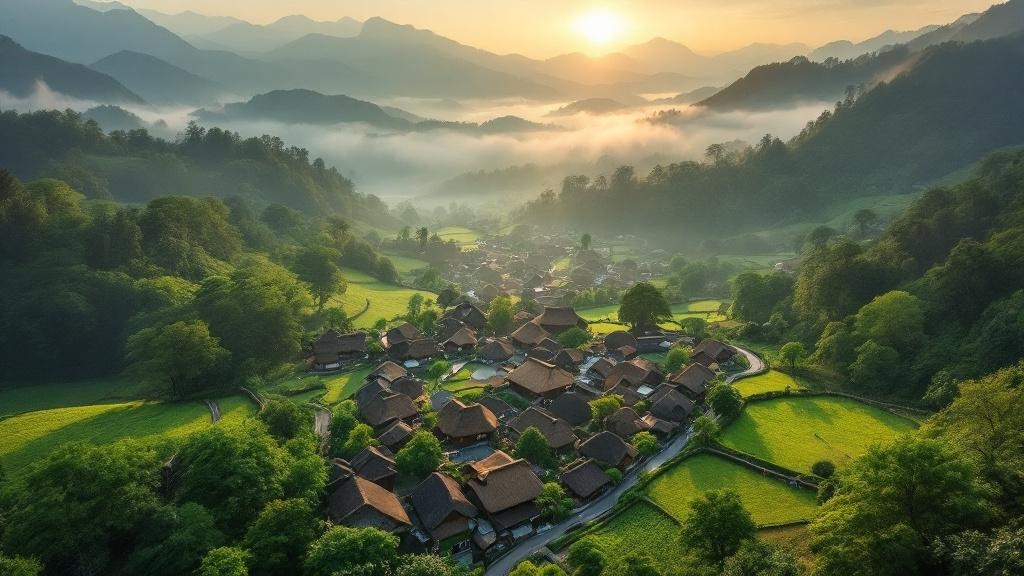
Miyama sits in the mountainous center of Kyoto Prefecture. Its population is roughly 3,500, spread across 340 square kilometers of forested landscape. The town is home to 39 preserved thatched-roof houses — a striking visual asset, but one that for decades attracted only occasional domestic day-trippers.
The inflection point came with structured governance. In 2016, the town established the Kyoto Miyama Tourism Association as a registered DMO. By 2017, the association had registered as a licensed travel agency — a critical step that shifted Miyama from passively receiving visitors to actively designing and selling tourism products.
The revenue model is built on deliberate local procurement. One-day tours use bus companies, guides, lunch venues, and roadside stations based entirely within Miyama. This high local procurement strategy ensures that tourism income circulates within the community rather than leaking to external suppliers. The DMO also developed specialized experience products such as the *Kayabuki Oyatsusanpo* — a thatched-village walk with local snacks — directly addressing what the town identified as sluggish per-visitor spending.
Conservation funding is baked into the business model. The eastern portion of Miyama includes the Kyoto University Ashiu Research Forest, home to one of the finest beech forests in western Japan. Trekking tours charge a fee of JPY 300 per participant, with proceeds allocated directly to forest conservation. Parking fees at the Kayabuki no Sato heritage site fund thatched-roof replacement — a maintenance expense that was previously a financial burden on residents.
The results speak for themselves. Annual visitor numbers reached approximately 700,000, and Miyama earned recognition as a UN Tourism Best Tourism Village — one of only eight certified destinations in Japan by 2024. This best tourism village Japan case study demonstrates that a structured DMO, a disciplined procurement strategy, and a clear revenue-to-conservation linkage can transform a remote hamlet into an internationally recognized destination.
Aya Town, Miyazaki: A 50-Year Head Start on Biodiversity Targets
Most eco-tourism projects frame sustainability as a future goal. Aya Town, in Miyazaki Prefecture, has been practicing it for over half a century. The town has protected Japan’s largest lucidophyllous forest — an evergreen broadleaf ecosystem — since the 1960s, while simultaneously promoting natural ecological agriculture across the entire municipality.
What makes Aya remarkable is not preservation alone, but active restoration. Under a multi-party partnership, the town committed to a 100-year forest restoration project that converts sections of planted cedar forest back to native broadleaf species. This is not a marketing exercise. The timeline reflects realistic forest succession dynamics — the kind of generational commitment that international conservation bodies increasingly recognize as the standard for credible biodiversity work.
The public-private AEON forest partnership anchors the town’s experiential tourism offering. This initiative, combining corporate community investment with municipal environmental goals, creates accessible natural spaces where visitors can directly engage with biodiversity. The project is designed with multiple engagement modes — from passive appreciation to active participation in restoration activities — making it adaptable across visitor demographics.
Aya’s position is unique in the sustainability landscape: the town has effectively met the Convention on Biological Diversity’s 2050 targets decades ahead of schedule. For operators and local governments evaluating eco-tourism models, Aya demonstrates that long-term environmental commitment is not just ethically sound — it produces a destination asset that cannot be replicated overnight by competitors.
Amagi Town, Kagoshima: Circular Agriculture as Tourism Content

In 2024, Amagi Town in Kagoshima Prefecture became the first community in western Japan to receive UN Tourism’s Best Tourism Village designation. It was selected from 260 global entries in the 2024 awards cycle — a competitive field that underscores the credibility of its achievement.
Amagi’s distinctive model turns circular agriculture into visitor-facing content. The town operates a closed-loop system where sugarcane leaves feed cattle, and cow dung is composted back into soil fertility for crop production. This reduces dependence on synthetic fertilizers, minimizes waste, and creates multiple revenue streams for farming households. The system itself has become a tourism product: visitors experience the agricultural cycle firsthand, connecting environmental sustainability with the food on their plate.
The tourism dimension serves a structural economic purpose. Rural depopulation and urban outmigration threaten farming communities throughout Japan. In Amagi, tourism revenue stabilizes farming household incomes by creating demand for local agricultural products at premium prices. Visitors pay more for food marketed as sustainably produced through circular methods, and that revenue underwrites continued agricultural operations that might otherwise be abandoned. The model is a practical answer to one of rural Japan’s most urgent demographic challenges.
Oyama Town, Oita: Inclusive Employment Through Nature-Based Tourism
Oyama Town in Oita Prefecture lacks the dramatic natural features that typically anchor a tourism brand — no UNESCO World Heritage Site, no iconic mountain, no coastal scenery. What makes Oyama a compelling community-based tourism Japan example is precisely this ordinariness. The town demonstrates that effective eco-tourism development does not require exceptional geography.
Since the early 2000s, Oyama has pursued nature-based tourism across a diversified portfolio: green tourism, landscape tourism, and agricultural tourism. An ethnographic study of the community documented how this strategy enabled residents to identify, conserve, and capitalize on latent local resources — assets that had economic value but had gone unrecognized or underutilized for generations.
The employment effects are particularly notable. Nature-based tourism in Oyama expanded income opportunities specifically for women and elderly residents, two demographics that often face economic marginalization in rural labor markets. Tourism activities promoted farm products and local cultural traditions while facilitating the transmission of traditional environmental knowledge between generations — a form of cultural preservation that produces tangible economic returns.
The research concluded that Oyama provides “an important lesson on how small communities in rural areas can be successful in sustaining their communities through community-oriented nature-based tourism.” The model is replicable because its success comes not from unique assets but from deliberate, strategic application of tourism development principles in a context of structural disadvantage. For SMEs operating in regions without marquee attractions, Oyama is arguably the most relevant case in this series.
Nishikawa Town, Yamagata: Digital Integration Meets Traditional Culture

Nishikawa Town in Yamagata Prefecture earned its Best Tourism Village designation in 2024, distinguished by a strategic approach that integrates digital technology with traditional cultural and natural assets. The town’s Tourism Strategy Book 2024 articulates its positioning with precision: a destination “where you can be natural and feel natural.”
Behind that tagline sits a structured four-pillar framework:
| Pillar | Objective |
|---|---|
| **Earn** | Create attractive industries and jobs integrating local resources with digital technology |
| **Connect** | Build open communities that value partnerships |
| **Nurture** | Support education and protect region-specific learning |
| **Support Each Other** | Foster communities where residents live with security and quality of life |
This framework is worth studying because it explicitly balances economic growth with resident well-being — recognizing that tourism sustainability depends on whether locals actually want to stay. A destination where residents are unhappy or economically squeezed will eventually lose the human infrastructure that makes it authentic.
Nishikawa’s digital technology adoption addresses a specific market access problem. Small, remote communities have historically been locked out of international visitor markets because they lacked the marketing reach and booking infrastructure that large tour operators command. Digital platforms change that equation. By investing in digital-first market access, Nishikawa can reach international travelers directly, reducing dependence on intermediaries and capturing more revenue per booking.
The town also pursues a collaborative regional approach, involving surrounding municipalities in the creation and sale of expanded travel products. This regional cooperation acknowledges that contemporary travelers evaluate destinations as experiences, not administrative boundaries. A multi-town itinerary is more compelling than a single-village visit — and shared marketing costs make international promotion affordable for communities that could not fund it individually.
Common Patterns Across All Five Cases
Despite their geographic and economic diversity, these five communities share structural patterns that explain their eco-tourism development results in Japan. Understanding these patterns is more valuable than studying any single case in isolation.
| Pattern | How It Appears in Practice |
|---|---|
| **Strong local governance** | Miyama’s DMO, Amagi’s multi-stakeholder council, Nishikawa’s four-pillar strategy |
| **Revenue-to-conservation linkage** | Miyama’s JPY 300 trekking fee, Aya’s restoration funding, Amagi’s circular agriculture support |
| **Visitors as collaborators** | Miyama’s explicit framing of tourists as preservation partners, Aya’s participatory restoration activities |
| **Phased development** | Aya’s 100-year timeline, Miyama’s decade-long DMO evolution, Oyama’s multi-year portfolio build |
Governance Comes First
Every successful case features a formal governance structure — a DMO, a multi-stakeholder council, or a strategy framework with defined accountability. Governance precedes product development because without coordinated decision-making, tourism revenue leaks to external suppliers, environmental assets get overexploited, and community resentment builds. The Japan Tourism Agency has invested approximately 960 million yen to support 46 regions in building exactly this kind of governance infrastructure between 2022 and 2024.
Conservation Must Pay for Itself
In every case, environmental protection is funded through tourism revenue rather than depending solely on government budgets or donations. This creates a self-reinforcing cycle: conservation maintains the destination’s appeal, which generates visitor revenue, which funds further conservation. Research across Japanese protected areas confirms that eco-tourism positively supports biodiversity conservation by raising awareness, generating funding, and promoting community involvement — provided that management structures like zoning, visitor education, and stakeholder collaboration are in place.
Visitors Become Stakeholders
Miyama explicitly frames visitors as “collaborators in helping to preserve Miyama for the future.” This is not just branding. When travelers understand that their spending directly funds roof restoration or forest conservation, satisfaction metrics improve and repeat visitation increases. Research indicates that educational briefings about ecosystem health influence visitor behavior positively, turning passive consumers into active conservation participants.
Years, Not Months
None of these transformations happened quickly. Aya’s conservation foundation spans five decades. Miyama’s DMO evolution took years. Amagi’s circular agriculture system was built over generations of farming practice before it became tourism content. This matters for decision-makers evaluating eco-tourism development expertise from DMPJ or any other partner: eco-tourism is a long-term investment, not a campaign. The communities that succeed are the ones that plan in phases, measure in years, and resist the temptation to optimize for short-term visitor volume over long-term community value.
What SMEs Can Take Away
These five eco-tourism success stories from Japan share one more thing: none of them were built by large corporations or international hotel chains. They were built by small communities, local operators, and municipal governments working with partners who understood their specific context. The governance frameworks, conservation funding models, and phased development strategies documented here are directly applicable to SMEs and regional operators evaluating their own eco-tourism potential.
The government infrastructure supporting this work continues to expand. Japan’s Environment Ministry targets 14 million foreign visitors to national parks by 2030, with per-visitor spending targets of ¥300,000 — a clear signal that the national strategy favors high-value, experience-intensive tourism over volume. The Japan Tourism Agency’s sustainable tourism development programs provide direct funding, governance consulting, and international certification support to qualifying regions.
For operators and destinations ready to move from interest to action, the path is clear: establish governance, link revenue to conservation, design experiences that position visitors as stakeholders, and commit to phased development measured in years. The proof that it works is in Miyama’s visitor numbers, Aya’s forests, Amagi’s farming households, Oyama’s employment data, and Nishikawa’s strategy framework.
These communities didn’t build their eco-tourism success alone — they worked with partners who understood both their local context and the international market. DMPJ brings the same combination of deep local knowledge and global marketing expertise to every engagement. Discover how our eco-tourism development services can help your region or business write its own success story.
Sorry, the comment form is closed at this time.