


36 Maritime and Aquaculture Innovation | DMPJ
At Daisho Media Partners Japan (DMPJ), we are your strategic partner in Japan’s rapidly evolving maritime and aquaculture sector — a USD 4.07 billion sustainable market projected to reach USD 5.46 billion by 2030. With an aging workforce averaging over 65 years, feed costs consuming 50–60% of operating budgets, and global buyers demanding digital proof of sustainability, Japan’s marine industries stand at a decisive inflection point. We help international and domestic companies navigate this transformation with bilingual consulting, phased technology integration, government funding strategy, and deep expertise in Japan’s regulatory framework and fishery cooperative network.
Explore Our Blog
Insights on Smart Fisheries, AI Aquaculture & Maritime Innovation
From AI-powered feeding systems and government funding guides to real SME case studies and ROI frameworks — our blog covers the data, strategies, and hard numbers driving Japan’s maritime and aquaculture transformation.

Our Service Offerings
1. Smart Fisheries & Aquaculture
-
-
Enhancing marine production through AI, IoT, and data-driven precision.
- AI-powered feeding systems achieving 86.7% accuracy — reducing feed costs by 10–20% and nitrogen discharge by 22%
- Real-time IoT environmental monitoring for water quality, temperature, dissolved oxygen, and early algal bloom detection
- Digital twin platforms enabling 12% net profitability gains through optimized feeding and predictive net-damage detection
-
2. Sustainable Marine Operations
-
-
Integrating decarbonization and eco-certification into maritime operations.
- Carbon-neutral shipping strategy aligned with Japan’s proposed $56/tonne carbon tax — anticipated to generate ¥300 billion annually
- Ammonia and hydrogen fuel transition supported by ¥2.8 trillion in Green Innovation Fund resources
- Smart port development with hydrogen refueling clusters — up to 40% capital cost coverage through MLIT programs
-
3. Advanced Marine Research & Development
-
-
Connecting cutting-edge marine technology with commercial deployment pathways.
- Autonomous vessel navigation under the MEGURI2040 initiative — Level 4 systems verified by MLIT, achieving 32.7% crew cost reduction
- Biomimetic inspection robotics reducing offshore wind blade downtime by 42.7% and high-risk incidents by 95%
- Land-based recirculating aquaculture systems (RAS) — Japan’s fastest-growing segment, expanding from ¥12 billion to ¥33 billion by 2030
-
4. Coastal & Offshore Infrastructure Solutions
-
-
Developing next-generation maritime infrastructure with measurable impact.
- Offshore wind farm maintenance robotics — adding 2.8 months of productive operation per year per installation
- AI-driven maritime security and surveillance systems integrated with autonomous monitoring
- Hydrogen and ammonia refueling infrastructure at strategic ports including Chiba, Yokohama, and Kobe clusters
-
5. Seafood Supply Chain Optimization
-
-
Building transparent, traceable, and globally competitive seafood logistics.
- Blockchain traceability achieving 60–75% faster verification — replacing paper-based systems that vary by cooperative
- Cold chain logistics optimized for Japan’s seafood market, projected to reach $26.7 billion by 2032
- MSC, ASC, and Marine Eco-Label Japan certification support — unlocking 10–15% export price premiums
-
6. Government Funding & Market Entry Strategy
-
-
Navigating Japan’s ¥2.5 trillion+ funding landscape and cooperative network.
- MAFF, MLIT, METI/NEDO subsidy identification and compliant application structuring across quarterly and annual cycles
- Fishery cooperative partnership development — essential for market access, licensing, and 70% of seafood distribution
- Multi-program bundling strategy achieving 35–40% effective cost reduction on total project investment
-
Japan’s Maritime Innovation by the Numbers
USD 4.07B
Japan’s sustainable aquaculture market value in 2024 — projected to reach USD 5.46 billion by 2030
2.8% CAGR
Aquaculture production growth through 2033 — from 999,800 to 1,280,000 metric tons
¥2.5T+
Available government funding across MAFF, MLIT, METI/NEDO, and prefectural innovation programs
35–40%
Effective cost reduction achievable by bundling multiple subsidy and tax incentive programs
Japan’s aquaculture workforce has halved over two decades to roughly 137,000 workers — with an average operator age exceeding 65. At the same time, the smart aquaculture market is projected to reach ¥10.6 billion by 2030, and 662 land-based facilities are reshaping production from the ground up. The question is no longer whether to modernize, but how to capture the opportunity before competitors do.
Why Choose DMPJ for Maritime Innovation?
- Sustainable & Smart Solutions: Implementing AI and IoT systems that have delivered 18.7% feed cost reductions and 12% profitability gains at documented Japanese facilities — replacing guesswork with data-driven precision across the production cycle.
- Eco-Friendly Marine Practices: Supporting carbon-neutral shipping aligned with Japan’s proposed $56/tonne carbon tax, leveraging ¥2.8 trillion in Green Innovation Fund resources for maritime decarbonization.
- Innovative Research Partnerships: Bridging Japan’s marine R&D institutions with global technology firms — where 78% of successful deployments involve strategic foreign-domestic partnerships integrated with local operational expertise.
- Global Market Integration: Connecting Japanese seafood industries to premium global markets through blockchain traceability, international certifications (MSC, ASC, Marine Eco-Label Japan), and bilingual stakeholder engagement that unlocks 10–15% export price premiums.
Our Approach
01 Needs Analysis & Environmental Assessment
Evaluating maritime challenges, workforce demographics, regulatory requirements, and infrastructure readiness across your target facilities and supply chain.
02 Strategic Planning & Technology Integration
Designing phased technology roadmaps leveraging Japan's ¥2.5 trillion+ funding landscape to offset 35–40% of implementation costs.
03 Implementation & Deployment
Deploying proven smart technologies with hybrid human-AI decision protocols that drive 3.8x higher adoption rates than top-down mandates.
04 Performance Monitoring & Data Analytics
Continuous optimization through IoT sensors, digital twin simulation, and real-time AI analytics — documented to reduce nitrogen discharge by 22% and labor hours by 35%.
05 Expansion & Future-Proofing
Scaling from pilot to full production with subsidy-bundled funding packages, aligned with Japan's evolving carbon tax and certification requirements.
Documented Results from Japan’s Maritime Sector
These outcomes come from named companies deploying proven technology at Japanese facilities — not vendor projections. Every result met the 36-month payback threshold that 87% of Japanese SME budget approvals demand.
Smart Aquaculture Feeding
-
-
Umitron AI deployment across 40+ Japanese coastal farms
- 18.7% average feed cost reduction (¥12.3M/year at 200-ton scale)
- 14.2% net profitability increase
- 22.4% nitrogen discharge reduction
- 35% labor hours saved on feeding operations
-
Autonomous Coastal Navigation
-
-
MEGURI2040 Level 4 autonomous vessel — first in commercial service (Jan 2026)
- 32.7% crew cost reduction
- 14.3% fuel efficiency improvement through AI-optimized routing
- 78% reduction in near-miss incidents
- 98.7% on-time performance (up from 92.3%)
-
Digital Twin Precision Farming
-
-
Takashima Tuna Farm — sonar AI with Sojitz Corporation partnership
- 12% net profitability increase in year one
- 86.7% satiety detection accuracy (vs 65% manual observation)
- 22.3% feed waste reduction
- 92% reduction in stock losses from net damage
-

Industries We Serve
Fisheries & Aquaculture
Maritime Shipping & Logistics
Marine Technology & Research
Environmental Conservation
Ocean Energy & Infrastructure
Latest Insights on Maritime And Aquaculture Innovation
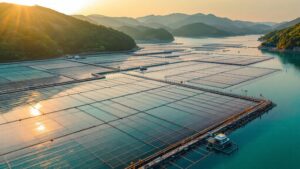
Smart Aquaculture in Japan: How AI and IoT Are …
Discover how AI, IoT, and data-driven technologies are transforming Japan’s ¥1.5 trillion aquacultur
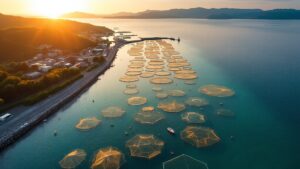
Japan Government Funding for Maritime and Aquac…
Complete guide to Japan’s government subsidies, grants, and low-interest loans for maritime and aqua

AI-Powered Aquaculture vs Traditional Japanese …
AI aquaculture vs traditional fish farming in Japan: hard data on feed savings, labor, and risk. Fin
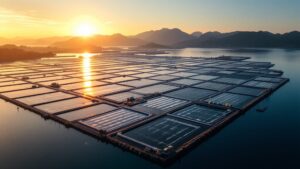
From Pilot to Profit: 5 Japanese SME Case Studi…
See how 5 Japanese SMEs achieved real ROI from smart aquaculture, autonomous shipping, and maritime

How to Choose a Maritime Innovation Consulting …
A structured framework for evaluating maritime innovation consulting partners in Japan. Covers five
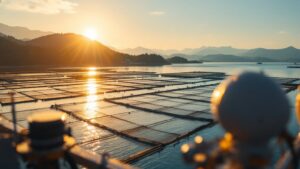
The Real Cost of Maritime and Aquaculture Innov…
Real budget ranges (¥5M–¥500M), documented ROI data, and subsidy offsets for aquaculture technology
Our Projects
Sorry, no posts matched your criteria.
Frequently Asked Questions
What ROI can maritime innovation deliver in Japan?
Documented deployments show 14–19% net profitability increases for smart aquaculture, 32% crew cost reductions for autonomous shipping, and 42% downtime reductions for robotic maintenance. Japanese budget culture requires full cost recovery within 36 months — and proven technologies consistently meet that threshold, with smart feeding systems paying back in 18–24 months.
What government funding is available for maritime projects?
Japan offers over ¥2.5 trillion in maritime innovation funding across MAFF, MLIT, METI/NEDO, and prefectural programs. Individual programs range from zero-interest ¥500 million fisheries loans to ¥6.5 billion zero-emission shipbuilding subsidies. Companies that strategically bundle multiple sources achieve 35–40% effective cost reductions on total project investment.
Do foreign companies need a local partner in Japan?
Most MAFF and Fisheries Agency programs require partnership with a local fishery cooperative. MLIT shipbuilding programs require domestic shipyard collaboration. Japan’s cooperatives control roughly 70% of seafood distribution channels. DMPJ helps structure these partnerships before filing — avoiding the most common disqualification for foreign-affiliated applicants.
How long does technology implementation take?
Small-scale IoT and monitoring initiatives (¥5–25M) take 3–6 months. Integrated digital twin and autonomous systems (¥25–100M) require 6–18 months. Full fleet or multi-facility transformations (¥100–500M) run 18–36 months. 78% of successful Japanese implementations use phased deployment, starting at 30–50% of target scale before expanding based on proven results.
Partner with us to unlock Japan’s maritime and aquaculture transformation — backed by ¥2.5 trillion in government innovation funding and proven technology delivering measurable results.
Get in Touch
CONTACT US