
28 Apr Launching a Media Project in Japan: A Step-by-Step Playbook for International Companies
Japan’s domestic video production services market reached ¥4,238 billion in fiscal 2024, with video advertising alone surpassing the ¥1 trillion mark for the first time in 2025. These numbers explain why international companies are lining up to produce content here. But between the permit paperwork, visa categories, and business culture that rewards relationships over transactions, the gap between wanting to produce in Japan and actually pulling it off is significant.
This japan market entry media production guide walks you through every phase — from strategic groundwork four months before production to sustaining a long-term Japan presence after your first project wraps. Whether you are shooting a brand campaign, a corporate documentary, or a full commercial series, this is your foreign company media production japan checklist.
Before You Fly — Strategic Groundwork (Months 4–3 Before Production)

Define Measurable Project Goals Tied to Business Outcomes
The most common mistake foreign companies make when launching a media project in Japan step by step is treating it as a purely creative exercise. Before a single location scout begins, tie your project to concrete business outcomes: lead generation targets, brand awareness benchmarks in a specific Japanese demographic, or conversion rates from a campaign landing page. Japan’s management consulting market is valued at $7.57 billion and growing at 10.78% CAGR, reflecting how seriously companies here take strategic alignment. Your project brief should read like a business case, not a mood board.
Identify Your Japan-Side Production Consultant
Your production consultant is your single most important hire. They handle vendor introductions, permit coordination, cultural translation, and stakeholder management — functions that are nearly impossible to replicate remotely. Begin relationship-building early. Japanese business culture rewards sustained engagement, and a consultant who has spent two months understanding your brand will deliver materially better outcomes than one onboarded the week before pre-production. To start your project with DMPJ’s production consulting, initial scoping typically begins in this strategic phase.
Budget Allocation
Set aside 15–25% of your total project budget for consulting, permits, and contingency. This is not padding — it reflects the real cost of navigating a production environment where permit processes require consensus from neighborhood police, residents’ associations, and local businesses rather than a single municipal film office. Japan’s location production incentive program offers cash rebates of up to 50% on eligible expenses (capped at ¥1 billion), which can offset a substantial portion of this allocation for qualifying projects.
Begin Entertainment Visa Applications
Any foreign talent or crew member receiving compensation for creative work in Japan requires an Entertainment Visa. Since August 2023, this visa has been organized into four categories with varying education and experience requirements. The Certificate of Eligibility process alone takes one to three months, and the certificate expires 90 days after issuance. Start this process the moment foreign talent is confirmed — ideally three to four months before the first shoot day. Using a short-term business visa as a workaround for compensated creative work risks entry denial and production-halting delays.
Building Your Japan Production Team (Months 3–2)
Selecting Local Vendors
Equipment houses, post-production studios, and talent agencies in Japan operate within tightly networked ecosystems. Equipment rental standards, post-production workflows, and talent contracting practices differ substantially from Western production models, with more hierarchical structures and relationship-driven vendor selection. The right vendors are not necessarily the ones with the best English-language websites — they are the ones with track records on projects matching your scope and budget.
Why Your Consultant’s Network Matters More Than Online Directories
Japan’s production infrastructure rewards insider relationships. A consultant with ten years of local vendor relationships will secure better rates, faster turnarounds, and more reliable crews than any directory search. This is particularly true for talent agencies, where foreign companies often lack the established trust required to access top-tier performers. Your consultant’s Rolodex is not a convenience — it is a competitive advantage that directly affects production quality and cost efficiency.
Establishing Communication Protocols
Bridging time zones, language, and decision-making styles is where most cross-cultural media production workflows in Japan break down. Japanese teams operate on consensus (稟議 — ringi), which means decisions take longer but carry stronger organizational commitment once made. Establish clear protocols: who approves what, in which language, and within what timeframe. Daily async updates in both English and Japanese prevent the small misunderstandings that compound into expensive reshoots.
The Bilingual Project Brief
Agree on a single bilingual project brief that both headquarters and your Japan team can execute against. This document should cover creative direction, technical specifications, deliverable formats, timelines, and approval gates — in both languages. A brief that only exists in English will be reinterpreted by local teams; a brief only in Japanese will be invisible to your global stakeholders. The bilingual brief is the operational contract that keeps everyone aligned.
Permits, Compliance, and Location Lock (Months 2–1)
Filing Location Permits
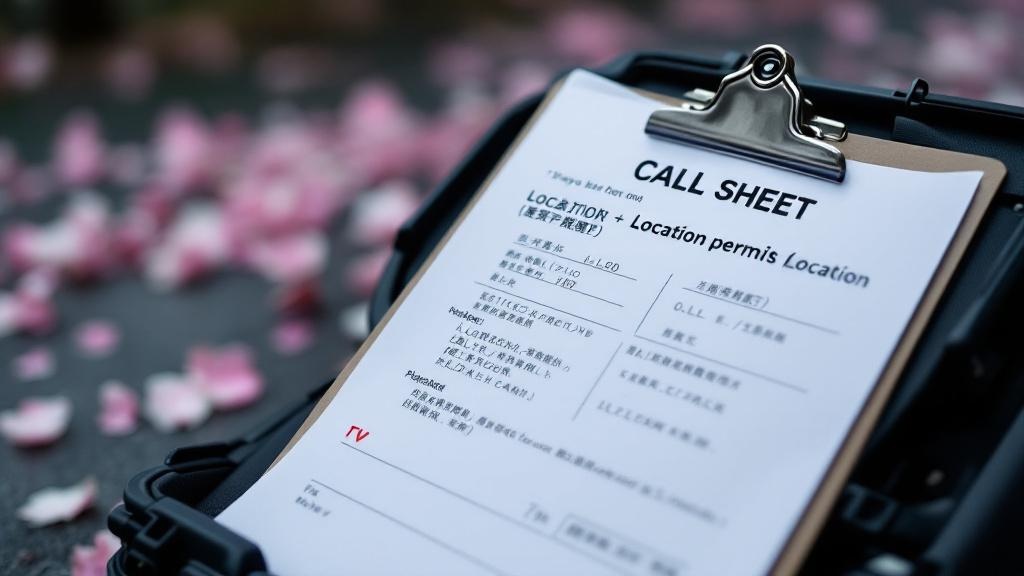
Start with your most complex location first. Japan’s revised Location Filming Handbook (March 2025) has streamlined some multi-jurisdiction processes, but lead times remain substantial and vary by location type.
| Location Type | Minimum Lead Time | Recommended Lead Time | Key Authority |
|---|---|---|---|
| Standard street | 1–2 weeks | 3–4 weeks | Local police station |
| Government building | 3–4 weeks | 6–8 weeks | Municipal film office |
| Heritage site / landmark | 6+ weeks | 3+ months | Cultural affairs dept. |
| Street closure (congested area) | 2–3 months | 6 months | Police + all affected residents/businesses |
| Drone filming | 10+ business days | 3–4 weeks | Aviation authority + local film office |
For street closures in congested areas like central Tokyo, advance coordination involving approval from hundreds of individual residences and businesses has been documented. The person who makes first contact with local stakeholders must continue all subsequent negotiations — relationship continuity is non-negotiable.
Advertising Compliance
Any content that will air or publish in Japan must comply with the Act against Unjustifiable Premiums and Misleading Representations (AUPMR) and, for health-related products, the Pharmaceuticals and Medical Devices Act. Comparative advertising is technically permitted but heavily restricted — claims must be backed by verifiable data, and pharmaceutical comparisons are limited to a company’s own product line. Violations can trigger cease-and-desist orders and fines of up to 3% of sales value over three years. Build compliance review into your production timeline, not after final cut.
Finalizing Contracts with IP Ownership Clauses
Japanese copyright law allocates ownership of cinematographic works differently than most Western jurisdictions. Under Article 29 of Japan’s Copyright Act, if an author participates in production under an agreement with the producer, copyright belongs to the producer. However, authors retain inalienable moral rights — including the right to prevent modifications that damage their honor or reputation. Your contracts must explicitly address these producer-copyright and moral rights structures. Performer neighboring rights add another layer: talent retains attribution and integrity rights that cannot be transferred by contract.
Insurance, Customs, and Safety Protocols
Public liability insurance typically requires $1–3 million USD in coverage, with higher amounts for shoots involving hazardous activities. Imported equipment requires customs documentation, and Japan Customs maintains specific temporary import procedures for production gear. Safety protocols must be proportional to your shoot scope and documented in permit applications.
Production Execution — On the Ground in Japan
Daily Bilingual Production Meetings
Once cameras roll, daily bilingual production meetings are your primary risk management tool. These are not status updates — they are structured sessions designed to surface issues before they compound. A problem identified at the morning meeting is a schedule adjustment; the same problem discovered at wrap is a reshoot.
The On-Set Consultant Role
Your production consultant serves three functions on set: quality oversight ensuring deliverables meet the standards defined in your bilingual brief, timeline enforcement keeping the schedule on track, and stakeholder liaison managing communication between your international team and local crew, vendors, and location contacts. This role is distinct from the director or line producer — the consultant operates at the intersection of business objectives and production execution.
Managing the Unexpected
Weather delays, permit amendments, and talent schedule changes are not edge cases — they are baseline expectations. Japan’s rainy season (June–July), typhoon season (August–October), and peak holiday periods all affect production logistics. Your consultant should maintain contingency plans for every primary location, including backup venues and revised schedules that can be activated within 24 hours. When permit amendments are needed, having an established relationship with local authorities dramatically reduces response time.
Cultural Etiquette on Set
Punctuality in Japan is not a suggestion — arriving even five minutes late signals disrespect. Hierarchy determines speaking order, seating arrangements, and the flow of decision-making. When working with local partners, exchanging business cards (meishi) with both hands remains standard protocol, and small gifts at the start and conclusion of a production relationship are expected. These are not formalities; they are the operational language of professional trust in Japan.
Post-Production, Delivery, and Knowledge Capture
Post-Production Workflow
Editing, localization, and format adaptation should be planned from the start, not improvised after the shoot wraps. If your content targets multiple platforms — broadcast, social, OTT — each requires distinct format specifications, aspect ratios, and captioning standards. Japan’s video advertising market is projected to reach ¥1.178 trillion in 2026, spread across platforms with wildly different technical requirements. Build platform-specific deliverables into your post-production schedule from day one.
Compliance Review of Final Deliverables
Run every final deliverable through compliance review against Japanese advertising and content regulations before distribution. This includes not only advertising claims but also talent image rights, music licensing, and any content that references health, financial, or pharmaceutical products. The cost of a compliance review is trivial compared to the cost of pulling a campaign after publication.
Project Retrospective
Document lessons learned while the experience is fresh. Which vendors exceeded expectations? Where did communication break down? What permit timelines proved optimistic? A structured retrospective creates institutional knowledge that reduces cost and risk on your next Japan production.
Knowledge Transfer
The best consulting relationships are designed to make the client progressively more capable. Your consultant should provide structured knowledge transfer — documenting vendor contacts, regulatory procedures, and cultural protocols — so your internal team builds Japan production literacy over time. Reducing dependency on external consulting does not eliminate the relationship; it elevates it from operational support to strategic partnership.
Sustaining Momentum — From One Project to an Ongoing Japan Presence
From Project-Based to Retainer
As your production volume in Japan grows, transitioning from project-based consulting to a retainer model provides cost predictability and ensures your consultant maintains continuous awareness of your evolving business context. Industry research suggests retainer-based consulting engagements range from ¥300,000 to ¥1,500,000 monthly depending on scope, compared to project-based fees of ¥1,000,000 to ¥5,000,000 per engagement.
| Engagement Model | Typical Cost Range | Best For |
|---|---|---|
| Project-based | ¥1M–5M per project | First production, defined scope |
| Hybrid (project + part-time retainer) | ¥1.5M initial + ¥300K/month | Recurring productions, 2–4 per year |
| Full retainer | ¥300K–1.5M/month | Ongoing Japan content operations |
Building Internal Japan Production Literacy
Structured capability development means more than hiring a bilingual coordinator. It means systematically transferring the knowledge your consultant holds — permit procedures, vendor relationships, cultural protocols, regulatory frameworks — into documented processes your internal team can execute. This is how you move from dependent outsourcing to informed partnership.
Establishing a Japan-Based Production Function
When your annual production volume justifies dedicated headcount and infrastructure in Japan, you have a decision: build an in-house Japan team or maintain a consultant partnership. In-house teams offer direct control and long-term cost efficiency but require sustained volume to justify fixed costs. Consultant partnerships maintain flexibility and access to broader networks. Most international companies find the optimal path is a phased transition — partnering with DMPJ for your Japan media project through initial productions, building internal literacy over two to three years, and selectively insourcing functions as volume and expertise justify it.
You have the playbook — now you need the partner to execute it. DMPJ’s Production Consulting Service provides end-to-end support from strategic planning through post-production delivery, backed by over a decade of bilingual expertise and deep industry networks across Japan. Contact DMPJ today to turn your Japan media project from plan into reality.
Sorry, the comment form is closed at this time.