


25 Jun Japan’s AgTech Market in 2026: Why Global Innovators Are Betting on Smart Farming
Japan is the world’s third-largest economy, yet its agricultural sector is running out of workers, running out of time, and increasingly turning to technology for answers. For global AgTech companies evaluating their next growth market, the japan agtech market size in 2026 tells a compelling story: billions of dollars in projected spending, aggressive government subsidies, and a farming population that quite literally cannot sustain itself without automation. This article breaks down the structural forces driving agricultural technology market japan growth, the specific segments attracting investment, and what the opportunity actually looks like for foreign companies with the right technology and the right strategy.
The Perfect Storm: Why Japan’s Farms Need Technology Now
Three forces are converging to create what may be the most urgent AgTech adoption cycle in any developed economy.
A labor crisis with no demographic fix. Over 80% of Japanese farmers are above 70 years old, and the farming population has been declining for decades. Unlike cyclical labor shortages that resolve with wage increases or immigration policy, Japan’s agricultural workforce gap is structural and irreversible within the current generation. There are simply not enough younger farmers entering the profession to replace those aging out, and the physical demands of farming make extended working lives impractical.
Food security as national policy. Japan imports over 60% of its food, a vulnerability that successive administrations have tried to address through self-sufficiency targets. Climate disruptions, geopolitical tensions, and pandemic-era supply chain breakdowns have elevated agricultural productivity from a policy preference to a security priority. The government’s response has been direct: allocate serious money toward technology that can maintain output with fewer hands.
Billions in targeted government spending. Recent budgets reflect the urgency. The Japanese government allocated JPY 15.6 billion for agricultural support services and JPY 8.9 billion specifically for technology development and supply acceleration, with additional funding directed toward regional agricultural structural transformation. These are not abstract R&D grants — they include subsidy programs that cover 50–70% of the cost of certified AgTech solutions, directly lowering the adoption barrier for farmers willing to modernize.
For foreign AgTech companies, this combination of desperate need, government backing, and an aging user base that will accept automation out of necessity (not preference) creates a smart farming japan opportunity unlike anything available in North America or Europe.
Market Size and Growth Projections Through 2034
The numbers behind Japan’s AgTech expansion are substantial across every major technology segment.
According to IMARC Group, Japan’s smart agriculture market reached USD 1.39 billion in 2025 and is projected to hit USD 4.46 billion by 2034, growing at a 13.87% CAGR. That growth rate outpaces most mature technology markets and reflects sustained demand rather than a single adoption wave.
The precision agriculture segment — encompassing data-driven crop management, variable-rate application, and field mapping — was valued at USD 602 million in 2025 and is projected to reach USD 1.36 billion by 2034 at a 9.51% CAGR. Grand View Research offers a slightly different cut, estimating 15.1% CAGR through 2030, which suggests the near-term acceleration may be even steeper than long-range models indicate.
Agricultural robotics tells the most dramatic story. The segment was valued at USD 434 million in 2025 with projections reaching USD 1.51 billion by 2034 — a 14.9% CAGR. Within this segment, agricultural drones have captured 43% of the market share, driven by their versatility across crop monitoring, precision spraying, and aerial data collection.
| Segment | 2025 Value (USD) | 2034 Projection (USD) | CAGR | Key Driver |
|---|---|---|---|---|
| Smart Agriculture (total) | $1.39 billion | $4.46 billion | 13.87% | Labor replacement, government subsidies |
| Precision Agriculture | $602 million | $1.36 billion | 9.51% | Data-driven crop optimization |
| Agricultural Robotics | $434 million | $1.51 billion | 14.9% | Autonomous field operations, drone adoption |
Underlying all of these segments, Japan’s IoT sensor market was estimated at USD 1.99 billion in 2024 and is projected to reach USD 11.28 billion by 2035 at a 17.08% CAGR — the foundational data layer that powers every other AgTech application.
Five Demand Segments Driving Adoption
Japan precision agriculture trends are not monolithic. Demand clusters around five distinct technology segments, each responding to a different structural pressure.
IoT Sensors and Precision Monitoring
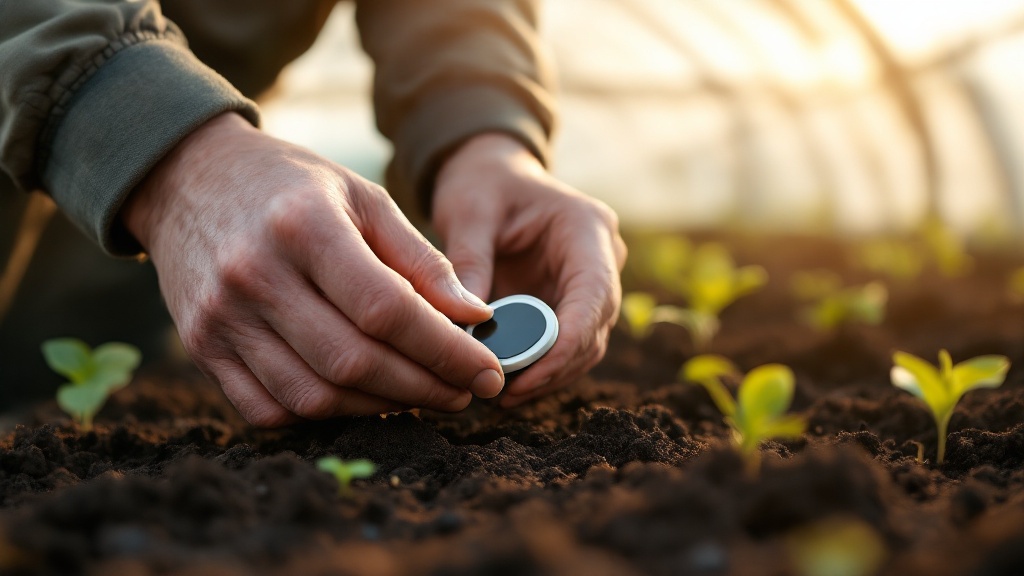
Rice remains Japan’s most important crop both culturally and economically, and IoT-based monitoring has become the entry point for many farms adopting technology for the first time. Soil moisture sensors, climate stations, and water-level monitors are being deployed across paddy fields to optimize irrigation timing and reduce the labor burden of manual field checks. For specialty crops like strawberries and melons — where micro-environmental control directly affects market price — sensor networks enable the kind of precision that aging farmers can no longer deliver through experience alone.
Agricultural Drones
Drones have become the dominant robotics product in Japanese agriculture, accounting for 43% of the agricultural robotics market. Their appeal is straightforward: Japan’s terrain is mountainous and fragmented, making ground-based machinery impractical for many operations. Drones handle crop monitoring across steep slopes, deliver precision pesticide spraying that reduces chemical usage by targeting only affected areas, and collect the aerial imagery that feeds AI-driven analytics platforms. Companies like DJI Agriculture have partnered with Syngenta Japan to develop safe spraying standards and training programs specifically for Japan’s multi-rotor agricultural drones.
AI-Driven Farm Management Platforms
As experienced farmers retire, their accumulated knowledge of soil conditions, pest patterns, and optimal planting schedules disappears with them. AI-driven platforms address this by codifying agricultural expertise into decision-support systems. Japanese AgTech companies like Seraku (with its CropScope platform) and Optim (with pinpoint pesticide application technology) have developed AI systems that analyze weather data, satellite imagery, drone footage, and sensor readings to provide actionable recommendations — effectively replacing decades of farming intuition with data-driven precision.
Food Supply Chain Traceability
Japanese consumers hold some of the world’s highest expectations for food safety and provenance. Traceability technology that tracks products from field to retail shelf has moved from a differentiator to a market requirement. The broader food traceability market exceeded USD 13 billion in 2024, growing at 13% CAGR, and Japan’s demand for verified quality attributes — pesticide-free status, organic certification, regional origin — is a significant driver.
Sustainable Farming Technology
Japan has set an ambitious target to cultivate 1 million hectares of organic farmland by 2050 — 25% of its total agricultural land. Reaching that goal requires technology that can reduce chemical fertilizer and pesticide usage while maintaining yields. Precision application systems, AI-powered integrated pest management, and soil health monitoring platforms are all seeing accelerated adoption as the government ties sustainability goals to subsidy eligibility.
| Demand Segment | Key Technologies | Primary Market Driver |
|---|---|---|
| IoT Sensors & Monitoring | Soil sensors, climate stations, water-level monitors | Labor reduction for aging farmers |
| Agricultural Drones | Multispectral cameras, precision sprayers | Terrain versatility; 43% of robotics market |
| AI Farm Management | Decision-support platforms, predictive analytics | Knowledge transfer from retiring farmers |
| Supply Chain Traceability | QR tracking, blockchain verification | Consumer quality and safety expectations |
| Sustainable Farming Tech | Precision inputs, organic transition tools | Government 1M hectare organic target by 2050 |
Japan’s Rising Share of Asian AgriFood Investment
The investment case for Japan’s AgTech sector has strengthened dramatically. According to AgFunder, Japan’s share of Asian agrifoodtech investment jumped to 13.0% in 2025 — up from just 6.1% in 2024. That more-than-doubling in a single year signals a fundamental shift in how investors evaluate Japan’s agricultural technology potential.
Japan is now the third-largest agrifoodtech funder in Asia, behind only India and China. The character of investment is also maturing: among the top five deals in 2025, three were deep-tech focused, including biotechnology companies and agricultural robotics startups. This pattern suggests investors are moving beyond consumer-facing food apps toward the fundamental production technologies that Japan’s farming sector actually needs.
A landmark deal in September 2024 reinforced this trend. SVG Ventures partnered with Kagome, one of Japan’s largest food companies, to launch a USD 50 million agritech startup fund with a ten-year investment horizon. The fund specifically targets business synergies between Japanese corporate agriculture and Silicon Valley innovation — a structure that creates natural entry points for foreign AgTech companies looking to access the Japanese market through established domestic partners.
For global AgTech innovators, these investment flows confirm that Japan’s market is not only growing in size but also building the financial infrastructure — venture capital, corporate partnerships, government grants — that supports sustained technology adoption rather than one-off pilot projects.
What This Means for Foreign AgTech Companies
Japan’s AgTech opportunity is real, but it comes with structural features that demand adaptation rather than transplantation of solutions built for Western markets.
Small Farms Require Adapted Technology
The average Japanese farm spans roughly 1.5 hectares — a fraction of the size typical in the US, Australia, or even much of Europe. Technologies designed for hundred-hectare commodity operations will not work here without significant modification. Drone systems need shorter flight plans, sensor networks need higher density per unit area, and robotics platforms need to handle the fragmented, irregularly shaped plots that define Japanese agriculture. Companies that approach Japan with a “same product, new market” mentality tend to stall at the pilot stage.
The JA Cooperative System: Gatekeeper and Gateway

Japan’s agricultural cooperative network (JA) controls significant portions of distribution, input supply, and farmer financing. For foreign companies, JA can feel like a barrier — but it also provides structured market access that bypasses the need to build farmer relationships one by one. Successful foreign entrants, including companies like Taranis (through Sumitomo Corporation’s investment), have used partnerships with Japanese trading houses or JA affiliates to gain distribution reach that would take years to build independently.
Government Subsidies Lower the Adoption Barrier
With subsidies covering 50–70% of certified AgTech solutions, the out-of-pocket cost for Japanese farmers drops substantially — but qualifying for these programs requires navigating complex application processes and meeting Japan-specific certification standards. Foreign companies that understand the subsidy landscape, or partner with local entities that do, gain a significant competitive advantage over those that price their products at full retail.
The common thread across all three factors: success in Japan’s AgTech market depends less on technological superiority and more on local market fluency. Understanding how JA cooperatives evaluate technology, how subsidy programs affect purchasing decisions, and how 1.5-hectare farms actually operate day to day is what separates viable market entry from expensive experimentation. This is precisely where DMPJ’s AgTech market entry services create value — bridging the gap between global innovation and Japan’s specific agricultural realities.
Japan’s AgTech market is growing at nearly 14% annually, but capturing that opportunity requires deep local knowledge. DMPJ’s agricultural technology consulting team helps global innovators navigate Japan’s unique farming landscape — from regulatory frameworks to JA cooperative partnerships. Explore DMPJ’s agricultural technology solutions to learn how we can tailor a market strategy for your technology.
Sorry, the comment form is closed at this time.