

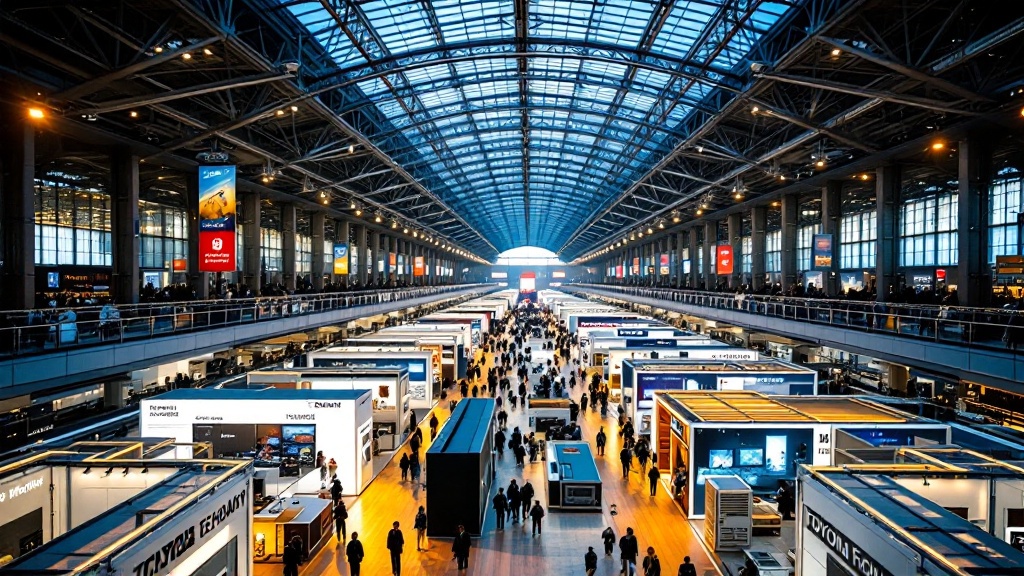
03 Jun What Does It Cost to Exhibit at a Technology Showcase in Japan? A Budget Planning Guide
The cost of exhibiting at a technology trade show in Japan is never just one number. Between mandatory infrastructure add-ons, digital presence requirements, and booth configuration premiums, most exhibitors discover their actual spend runs 2.5 to 3 times the published base rate. That gap is where budgets fall apart — and where planning makes the difference.
For many companies, an exhibition in Japan represents one of the largest single marketing expenditures of the year. Getting the numbers wrong, or missing available subsidies, can mean the difference between a successful market entry and a costly lesson. Japan tech exhibition budget planning requires working with real figures from named events, not averages pulled from global reports.
This guide maps current pricing at six major technology exhibitions, flags the hidden costs most first-timers miss, details the government subsidies that can slash your net investment by 40–60 percent, and benchmarks Japan against comparable events in the US and Europe. Whether you are a foreign company planning a first Japanese showcase or a Japanese SME building a case for international visibility, these numbers will help your finance team say yes.
Booth Costs at Japan’s Major Technology Events (2024–2026 Rates)
Japan’s technology exhibition calendar offers a wide range of entry points depending on your sector, booth size, and company stage. The table below summarizes current published rates at six flagship events, all quoted in Japanese yen with USD equivalents at ¥150/$1.
| Event | Venue | Standard Booth (9 m²) | Startup / SME Option | Notable Extra |
|---|---|---|---|---|
| [CEATEC](https://www.ceatec.com) | Makuhari Messe | ¥396,000 ($2,640) | ¥143,000 ($953) / 6 m² | Co-locates with Japan Mobility Show Bizweek |
| [BioJapan](https://jcd-expo.jp/en/exhibition.html) | Pacifico Yokohama | ¥572,000 ($3,813) | ¥352,000 ($2,347) / 6 m² | Early-bird discount saves ~10% |
| [SMART ENERGY WEEK](https://www.wsew.jp/hub/en-gb.html) | Makuhari Messe | From ¥484,000 ($3,227) | — | +¥330k–550k energy infrastructure |
| [Japan IT Week](https://www.japan-it.jp/hub/en-gb/exhibit.html) | Tokyo Big Sight | From ¥484,000 ($3,227) | — | DX Week sub-event: 10–15% premium |
| [Interop Tokyo](https://www.interop.jp/2026/en/about/) | Makuhari Messe | ¥440,000 ($2,933) | — | +¥275,000 mandatory connectivity |
| [ROBOT TECHNOLOGY JAPAN](https://robot-technology.jp/en/about/) | Aichi Int’l Convention Center | Est. ¥550,000 ($3,667) | — | +¥330,000 mandatory safety systems |
What the rates tell you
CEATEC offers the lowest barrier to entry among Japan’s major technology events. Its startup plan at ¥143,000 ($953) for 6 m² has drawn hundreds of emerging tech ventures annually, and the standard 9 m² rate of ¥396,000 ($2,640) remains the most competitive for established firms seeking broad technology-sector exposure. For companies evaluating the CEATEC exhibition cost per booth against other Japanese events, the combination of broad visibility and competitive pricing makes CEATEC the default starting point for first-time exhibitors.
BioJapan carries the highest base rate at ¥572,000 ($3,813) per 9 m², reflecting its specialized pharmaceutical and biotech audience. Committing before the early-bird deadline — typically mid-April — drops the price to roughly ¥517,000, and the startup plan at ¥352,000 ($2,347) includes a pre-fabricated booth structure that cuts setup costs. The early-bird discount applies across all plan types, so startups benefit equally from advance commitment.
SMART ENERGY WEEK starts at ¥484,000 ($3,227), but renewable energy exhibitors face ¥330,000–550,000 ($2,200–$3,667) in mandatory electrical and safety infrastructure for high-capacity power demonstrations. Budget the base rate plus at least ¥330,000 for any energy-sector exhibit.
Japan IT Week charges from ¥484,000 ($3,227), with the DX Week digital transformation sub-event commanding a 10–15% premium over standard rates due to heavier enterprise buyer traffic.
Interop Tokyo lists a moderate ¥440,000 ($2,933) base but adds a mandatory ¥275,000 ($1,833) connectivity package providing dedicated high-speed network access. For bandwidth-intensive demonstrations, that figure can double.
ROBOT TECHNOLOGY JAPAN carries an estimated base of ¥550,000 ($3,667). Japanese safety regulations require a minimum ¥330,000 ($2,200) investment in fencing, laser scanners, and emergency-stop equipment for any live robotic demonstration — a non-negotiable line item.
The Hidden Costs Most Exhibitors Miss
The published booth rate is just the starting line. Several required or near-required expenses routinely push total costs to 2.5–3 times the base.
Mandatory infrastructure packages
Every booth requires a baseline power, lighting, and connectivity package. At Makuhari Messe, expect ¥95,000 ($633); at events requiring guaranteed high-speed connections, that climbs to ¥180,000 ($1,200).
Partnering system accounts
BioJapan’s business matching platform is where the real deals happen, but your booth fee includes only 2–4 accounts. Each additional account costs ¥121,000 ($807), and serious exhibitors typically need 3–4 extras — adding ¥363,000–484,000 ($2,420–$3,227) that can exceed the base booth cost itself.
Digital showcase packages
CEATEC now mandates at least one Digital Showcase Package at ¥110,000 ($733) for access to its proprietary matchmaking platform. This trend is spreading: Japanese tech events increasingly treat digital presence as a required line item, not an optional upgrade.
Booth configuration premiums
Improved sightlines cost more. Standard single-side-open booths are the cheapest; opening additional sides escalates pricing quickly:
| Configuration | Surcharge Range |
|---|---|
| Corner booth (2 sides open) | ¥22,000–55,000 ($147–$367) |
| Peninsula booth (3 sides open) | ¥33,000–82,500 ($220–$550) |
| Island booth (4 sides open) | ¥55,000–137,500 ($367–$917) |
The multiplier rule
Once you add mandatory infrastructure, digital packages, partnering accounts, and even a modest corner premium, your total investment typically reaches 2.5–3× the published base rate. A ¥396,000 CEATEC booth becomes ¥990,000–1,188,000 ($6,600–$7,920) in practice. Build that multiplier into every internal budget proposal from the outset. This multiplier is not unique to Japan — US and European events carry similar hidden-cost ratios — but the gap between published rate and actual spend surprises first-time exhibitors in Japan more often because pricing is structured per booth unit rather than per square meter, making direct comparisons harder to run.
Government Subsidies That Can Cut Your Costs in Half
Japan offers one of the most generous government subsidy ecosystems for technology exhibition participants anywhere in the world. SMEs and foreign companies entering the Japanese market can tap national, agency-specific, and prefectural programs that collectively offset 40–60% of eligible exhibition costs.
| Program | Coverage | Cap | Who Qualifies |
|---|---|---|---|
| [JETRO FDI Stimulation Project](https://www.eu-japan.eu/events/jetros-subsidy-foreign-direct-investment-stimulation-project-accepting-applications) | 50% (SMEs) / 33% (large) | ¥15M ($100,000) | Foreign / foreign-affiliated firms |
| [SMRJ Exhibition Subsidy](https://www.smrj.go.jp/sme/overseas/exhibition/) | 50% | ¥500,000 ($3,333) | First-time Japanese SME exhibitors |
| Chiba Prefectural Grant | 30–40% | ¥300,000 ($2,000) | Firms with Chiba-based operations |
| AMED BioJapan Partnership | 40% | ¥400,000 ($2,667) | Health tech aligned with national priorities |
| METI Green Innovation Fund | Up to 50% | Uncapped* | Carbon reduction demos at SMART ENERGY WEEK |
*For projects exceeding 1,000-ton annual CO₂ reduction potential.
JETRO FDI Stimulation Project
The most impactful Japan exhibition government subsidy for SMEs entering the Japanese market. It reimburses up to 50% of eligible costs for qualifying small and mid-sized enterprises (33% for larger firms) with a generous ¥15 million cap — covering booth fees, prototype shipping, installation equipment, and on-site technical staffing. Applications typically close six months before the target event.
SMRJ Exhibition Participation Subsidy
Aimed at Japanese SMEs exhibiting at major domestic events for the first time. The 50% coverage (capped at ¥500,000) applies only to booth rental, basic construction, and promotional materials — digital add-ons and premium positioning are excluded.
Prefectural and sector-specific grants
Chiba Prefecture’s Makuhari Messe program reimburses 30% of booth costs for locally based companies, climbing to 40% through its Cluster Development Bonus for exhibitors in designated technology clusters like robotics or renewable energy. AMED’s BioJapan Partnership Program covers 40% (up to ¥400,000) for health tech companies aligned with Japan’s regenerative medicine and oncology priorities. And METI’s Green Innovation Fund reimburses up to 50% of SMART ENERGY WEEK costs for exhibitors demonstrating carbon reduction technologies, with uncapped funding for high-impact projects.
The stacking strategy
These programs are stackable within limits. A Japanese SME exhibiting at CEATEC could combine the SMRJ national subsidy (up to ¥500,000) with Chiba’s prefectural grant (up to ¥300,000), reducing net costs by 40–60% on eligible expenses. Foreign companies can layer JETRO’s FDI subsidy with prefectural programs, though most require Japanese business registration. Navigating these overlapping timelines and eligibility requirements is where DMPJ’s full-service technology showcase packages deliver outsized value — the team handles subsidy applications, documentation, and coordination so you capture every eligible offset.
Japan vs. Global Events — Where Your Budget Goes Further
How does Japan stack up against CES in Las Vegas or MWC in Barcelona? The headline numbers favor Japan, but the real story depends on which costs you count.
Base rate advantage: 43% lower
A standard 9 m² booth at CEATEC costs $2,640 versus roughly $4,600 at CES for a comparable 10×10-foot space — a 43% difference at the base level.
The add-on reality
That gap narrows quickly. CES bundles basic infrastructure into its base rate, while Japanese events charge separately for power, connectivity, and digital packages. Once mandatory add-ons are included on both sides, the Japan cost advantage shrinks to 5–10%.
Subsidies restore the gap
Japan’s government subsidy programs have no direct equivalent at US or European events. With eligible subsidies applied, net exhibition costs in Japan can run 25–40% lower than comparable US and European showcases — a meaningful difference for budget-conscious SMEs.
Personnel costs favor Japan
Travel and accommodation costs are often the tie-breaker. Tokyo hotel rates average around $233 per night for business-grade accommodation, compared to $271 in Barcelona during MWC and similar premiums in Las Vegas during CES. Over a five-day exhibition with a three-person team, that differential alone saves $570–$800. When benchmarking against European events specifically, MWC Barcelona’s medium stand packages start around €15,000–35,000 for 21–75 m², and Hannover Messe begins at roughly €650 per square meter — both higher than Japanese equivalents before subsidies enter the equation.
The bottom line: if your target market is Japan, exhibiting domestically delivers better value at every budget stage. If you are comparing Japan against a global event for worldwide visibility, Japan’s subsidized costs still compete strongly — particularly for SMEs qualifying for 50% reimbursement through JETRO or SMRJ programs.
Building Your Business Case — ROI Metrics That Win Budget Approval

Knowing what you will spend is only half the equation. Finance teams and executive sponsors want to know what you will get back. The following frameworks move the conversation from booth costs to demonstrable business value, and they are essential for anyone evaluating technology showcase ROI in Japan.
Move beyond attendance counts
Counting badge scans tells you how many people walked past your booth. It says nothing about business outcomes. Structure your measurement around a KPI chain that tracks progression: leads captured → qualified leads → sales conversations initiated → proposals sent → deals closed. Each stage should have a target number before you book the booth. This funnel approach also makes it easier to pinpoint where your exhibition strategy is underperforming. If you generate 100 leads but only 5 become sales conversations, the problem is lead quality or follow-up execution — not the event itself.
Pre-event preparation drives results
Research on trade show planning effectiveness shows that companies investing 40–60% of their total exhibition effort in pre-event preparation — audience research, meeting scheduling, pitch customization — achieve 68% of their stated objectives. Companies that skip this preparation phase hit just 12%. The implication is clear: the largest single determinant of exhibition ROI is what happens before you arrive at the venue.
Cost per qualified lead
At Japanese technology events, the cost per qualified lead ranges from $30 to $200 depending on your sector and event selection. Biotech events with pre-scheduled partnering systems trend toward the lower end per qualified lead despite higher base costs, because the matching algorithms filter out casual browsers. Broad-audience IT events generate cheaper raw leads but higher cost-per-qualified-lead after disqualification.
The 48-hour follow-up rule
Data from event marketing research in Japan reveals a stark conversion gap: companies that follow structured post-event follow-up protocols — personalized outreach within 48 hours, tailored documentation within one week, and concrete next steps within three weeks — convert 85% of qualified leads into substantive engagements. Companies with slower or generic follow-up convert just 32%. In Japan’s relationship-driven business culture, prompt and thoughtful follow-up signals commitment and respect.
Frame the investment correctly
When presenting to executive sponsors, shift the conversation from cost-per-booth to cost-per-partnership. A ¥1 million all-in exhibition investment that generates three serious sales conversations and one closed partnership is not a ¥1 million booth expense — it is a ¥1 million business development investment with measurable returns. That reframing often makes the difference between budget approval and rejection, especially when decision-makers are comparing exhibition spend against digital marketing channels where cost-per-click is easy to calculate but cost-per-relationship is not.
Budgeting for a technology showcase in Japan doesn’t have to be guesswork. DMPJ provides transparent cost planning, handles subsidy applications, and manages every detail from booth design to post-event follow-up — so you know exactly what you’ll spend and what you’ll get. Request a customized estimate on our Technology and Innovation Showcases page.
Sorry, the comment form is closed at this time.