

08 Jun Planning a Bilingual Corporate Event in Japan: Lessons From Companies That Got It Right
Why Bilingual Events in Japan Demand a Different Playbook
Japanese business culture rewards precision and cultural respect. At an event, technical execution doesn’t run in the background — it *is* the trust signal. When a wireless microphone cuts out mid-keynote or a translation feed stutters during Q&A, Japanese decision-makers don’t just notice. They recalibrate their assessment of your entire organization.
That’s why standard international event templates fail when hosting a corporate event in Japan for foreign companies. The same slide decks, the same streaming setup, the same “we’ll sort it on-site” attitude that works in Singapore or San Francisco hits a wall in Tokyo, Osaka, or Nagoya. Three factors drive the gap.
Language goes deeper than translation. Bilingual events in Japan require more than hiring an interpreter. Your AV team needs to troubleshoot in both languages, your on-screen materials need to follow Japanese typographic conventions, and your audience interaction systems need to accommodate participants switching between languages in real time. Language barriers at meetings consistently rank among the top reasons international events underperform in Japan.
Aesthetic expectations are fundamentally different. Japanese audiences expect less text on screen, more visual harmony, and contextual data storytelling — not the bullet-heavy, animation-forward decks common in Western corporate events. Getting this wrong doesn’t just look bad. It signals a lack of cultural investment that undermines credibility with Japanese decision-makers.
Regulatory differences create real risk. Japan’s Radio Law, equipment safety certifications, and electronic product compliance standards differ materially from international norms. Using uncertified wireless equipment at a Japanese event isn’t just a technical mistake — it can result in confiscation and fines.
These aren’t edge cases. METI’s Foreign Business Environment Survey found that 78% of foreign companies in Japan report difficulty finding technical providers who understand both international standards and Japanese business protocols. That figure reveals a structural gap — and a planning opportunity for companies willing to invest in getting the technical layer right from the start.
Case Study: A Global Tech Company’s Japan Market Entry Event
The challenge
A global enterprise network provider — mid-sized, with roughly $500 million in annual revenue — had been trying to crack a target account list of Japanese enterprise buyers for over a year. English-only outreach wasn’t working. Standard digital marketing generated leads, but conversion rates in Japan lagged every other market. The problem wasn’t the product. It was the approach: Japanese enterprise buyers conduct extensive independent research before engaging directly, and they expect vendors to demonstrate commitment to the market through in-person presence and native-language engagement.
The solution
The company restructured its Japan strategy around a professionally produced bilingual event. The technical production included bilingual AV production with simultaneous interpretation systems integrated directly into the streaming architecture — not bolted on as an afterthought. Presentations were redesigned to match Japanese visual conventions: fewer bullet points, more contextual data storytelling, and transitions paced for the reflection time Japanese audiences expect. Japanese-native on-site technical staff handled troubleshooting in both languages, eliminating the communication lag that typically slows live event problem-solving.
Lead management was equally deliberate. Every lead was translated from Japanese to English, standardized for CRM integration, and delivered with bilingual reporting so headquarters could evaluate results without losing nuance.
The result
The outcomes were documented in detail by the agency that supported the campaign. The company achieved over 80% penetration of their target account list through precise targeting and multi-channel execution anchored by the event. Average cost per lead came in at $105, achieved through efficient asset use and channel optimization. Overall ROI hit 358%, converting marketing leads into real sales opportunities. Local sales representatives appreciated the Japanese-language engagement and on-site support that let them focus on relationships rather than troubleshooting, while headquarters got clean English reporting that demonstrated concrete business impact.
Key takeaway
Bilingual technical execution converted what had been a marketing problem — how to reach Japanese enterprise buyers — into a functioning sales pipeline. The event didn’t just generate awareness. It generated qualified opportunities because the technical layer communicated respect, precision, and commitment to the Japanese market.
Case Study: A Japanese SME Expanding to International Markets Through Hybrid Workshops

The challenge
A mid-sized Japanese manufacturer of precision industrial equipment faced a classic expansion problem. Their products required hands-on demonstration to appreciate, but their target buyers — engineers at foreign manufacturing companies — couldn’t justify the time or cost of traveling to Japan. Previous attempts at virtual product demonstrations using standard video conferencing tools had failed. Low-resolution video couldn’t capture the precision of the equipment, audio feedback made real-time Q&A frustrating, and the lack of interactive annotation tools left foreign engineers unable to ask the specific technical questions that would move them from curiosity to purchase intent.
The solution
The company invested in a series of technically sophisticated hybrid workshops, drawing on lessons from Japan’s evolving hybrid conference ecosystem. The production incorporated multi-angle camera setups with dedicated close-up feeds that captured the precision details engineers needed to evaluate the equipment. Real-time bilingual annotation tools allowed Japanese presenters to highlight specific components while English captions appeared simultaneously on the remote feed. A Japan-optimized streaming platform was tuned for low-latency delivery to target markets in Southeast Asia, Europe, and North America — avoiding the quality degradation that had plagued previous attempts using consumer-grade tools. Critical demonstration segments were pre-recorded as backup insurance against live connectivity issues.
The result
Within three months of launching the workshop series, the company saw a 63% increase in international inquiries compared to the prior quarter and generated 28 qualified leads from foreign manufacturers, including five that progressed to pilot project discussions. Remote participants spent an average of over eight minutes engaging with each demonstration — double the engagement time of previous virtual attempts.
Key takeaway
Technical production quality directly determined whether remote buyers took this manufacturer seriously. The same product, presented through consumer-grade tools, generated minimal interest. Presented through purpose-built multilingual event production, it generated a pipeline. The lessons learned from this Japanese SME apply broadly: if your international audience can’t see, hear, and interact with your offering at professional quality, they won’t buy.
| Metric | Global Tech Company | Japanese SME |
|---|---|---|
| Event format | In-person bilingual + streaming | Hybrid workshop series |
| Target audience | Japanese enterprise buyers | Foreign manufacturing engineers |
| Core technical investment | Bilingual AV, culturally adapted visuals | Multi-angle camera, annotation tools |
| Lead / inquiry growth | 80%+ TAL penetration | +63% international inquiries |
| Qualified pipeline | 358% ROI on event investment | 28 qualified leads in 3 months |
| Cost per lead | $105 | Not disclosed |
The Seven Technical Decisions That Determine Success or Failure
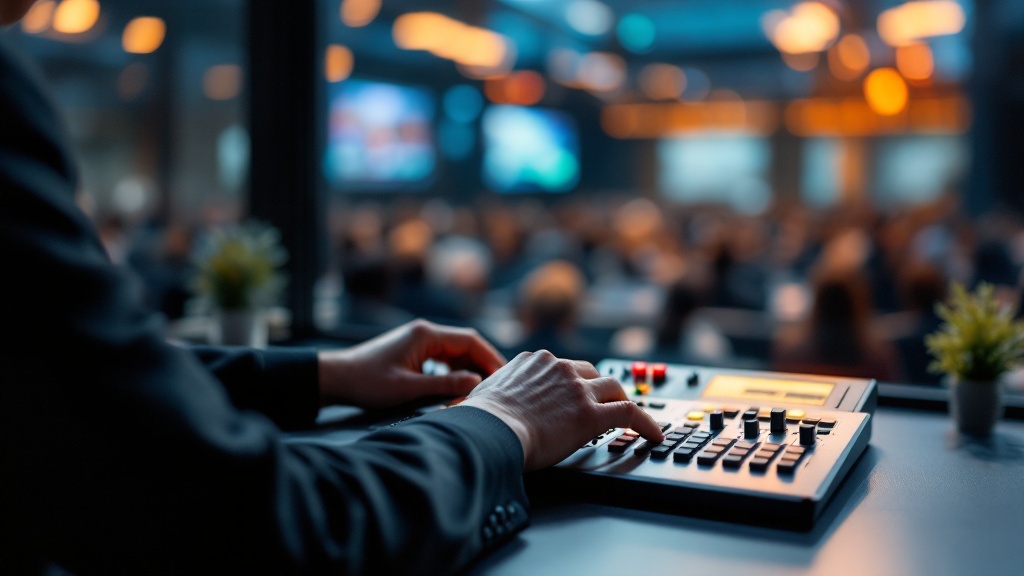
Every international business event Japan case study we’ve examined points to the same conclusion: success or failure is determined long before the event day. It’s determined in the planning decisions that shape the technical foundation. Here are the seven that matter most — each drawn from real-world multilingual event production Japan lessons learned.
| # | Decision | Why it matters |
|---|---|---|
| 1 | **Hire bilingual technicians, not just interpreters** | Your AV team must troubleshoot in both languages. An interpreter can translate a speaker’s words, but they can’t diagnose a feedback loop or reconfigure a streaming encoder under pressure. You need technicians who think in both languages. |
| 2 | **Verify all wireless equipment against Japan’s Radio Law** | Japan’s [radio frequency regulations](https://acbcert.com/japan-radio-regulations/) differ from international standards. Wireless microphones and presentation clickers that work legally in the US or EU may operate on prohibited frequencies in Japan. Verify compliance before shipping anything. |
| 3 | **Design visuals for Japanese aesthetic conventions** | Less text, more visual harmony, contextual data storytelling. Japanese business audiences [process information differently](https://nihonium.io/ultimate-guide-to-event-marketing-in-japan/) than Western audiences. Redesign your slides — don’t just translate them. |
| 4 | **Build structured pauses into the run-of-show** | Japanese audiences expect reflection time between segments. Packing the agenda wall-to-wall with content signals unfamiliarity with local business norms. Build in the space for the thinking that precedes Japanese decision-making. |
| 5 | **Use culturally appropriate camera work** | Avoid aggressive close-ups on individual speakers. Japanese business culture emphasizes the group, not the individual. Camera framing should reflect this — wider shots, ensemble compositions, and respectful distance during Q&A. |
| 6 | **Integrate with Japanese communication platforms** | Line is Japan’s dominant messaging platform, not WhatsApp or Slack. Build audience engagement — polling, Q&A, post-event follow-up — on the platforms your Japanese participants actually use. |
| 7 | **Budget a 30% contingency for Japan-specific adjustments** | From voltage differences to venue-specific AV restrictions to [equipment compliance requirements](https://incompliancemag.com/electronic-product-compliance-in-japan/), Japan introduces technical variables that standard international budgets don’t account for. A 30% contingency isn’t generous — it’s realistic. |
This is where working with a provider that understands both worlds pays for itself. When you partner with DMPJ for your next event in Japan, these seven decisions become part of the planning process — not surprises discovered on event day.
Your 90-Day Countdown to a Successful Bilingual Event
Planning a bilingual corporate event in Japan isn’t something you can compress into a few weeks. The companies that get it right — the ones generating 358% ROI and filling their sales pipeline — start at least 90 days out. Here’s how that timeline breaks down, based on what works.
| Phase | Timeline | Key actions |
|---|---|---|
| **Partner selection & compliance** | Days 90–60 | Select your bilingual technical production partner. Conduct a venue technical survey covering power capacity, AV infrastructure, internet bandwidth, and accessibility. Begin a [regulatory compliance audit](https://acbcert.com/japan-radio-regulations/) for all wireless and electronic equipment you plan to use in Japan. Confirm venue restrictions on outside AV vendors. |
| **Content & system design** | Days 60–30 | Localize all presentation content — not just translate, but culturally adapt. Finalize system design: camera positions, audio routing, streaming architecture, interpretation workflow. Assign bilingual technicians to specific roles. Test [hybrid event platforms](https://remo.co/blog/event-industry-statistics) against Japan-specific network conditions. |
| **Rehearsals & backup systems** | Days 30–7 | Run full rehearsals with live translation workflow — every speaker, every slide transition, every audience interaction point. Test backup systems: redundant internet, spare microphones, pre-recorded demonstration segments. Conduct a stakeholder walkthrough so that executives and sponsors see exactly what the audience will experience. |
| **Execution** | Event week | Final technical rehearsal with remote test participants in each target timezone. Run a formal go/no-go checkpoint 24 hours before doors open. Execute with [bilingual technicians on every position](https://globalproduce-event.com/journal/event/business-events-in-japan/) — no language gaps in the production chain. |
The 90-day structure isn’t about bureaucracy. It’s about removing uncertainty. The companies in our case studies didn’t succeed because they had bigger budgets. They succeeded because they made technical decisions early enough to execute them properly — and they worked with partners who understood the specific demands of bilingual event production in the Japanese market.
Japan’s event management software market is projected to grow at 16.7% annually through 2030, and 74.5% of event planners are now adopting hybrid formats. The technical complexity isn’t going away — it’s accelerating. Companies that build the right technical partnerships now will be the ones writing the next round of success stories. Those that try to import their standard playbook will keep wondering why Japan doesn’t convert.
The difference between a bilingual corporate event Japan planning guide that sits in a drawer and one that actually works is execution. And execution, in Japan, is a technical discipline.
You’ve seen what works — and what doesn’t — when it comes to bilingual event production in Japan. DMPJ’s Technical Support for Events exists to make your event the success story, not the cautionary tale. Our bilingual technicians, cutting-edge equipment, and deep Japan expertise are ready for your next event. Get in touch to start planning.
Sorry, the comment form is closed at this time.