

15 Jun Hybrid and Live-Streaming Event Production in Japan: What You Need to Know
The State of Hybrid Events in Japan in 2026
Hybrid event production in Japan is no longer a contingency plan. It is the default format for any corporate event that takes audience reach seriously. Japan’s virtual event market reached ¥135.6 billion in 2025 and is growing at an 11.4% compound annual growth rate through 2034, when it is projected to exceed ¥358 billion. That growth sits inside a broader event industry that the Japan Association of Convention Halls (JACE) valued at ¥28.5 trillion in 2024 — surpassing pre-pandemic levels by 9.2%.
The shift to hybrid is not unique to Japan, but the quality threshold is. Japanese audiences consistently demonstrate lower tolerance for technical imperfections — audio dropouts, visible latency, inconsistent framing — than most Western markets. A corporate livestream that would pass muster in New York or London may register as unprofessional in Tokyo. This expectation is rooted in decades of broadcast production standards set by NHK and Japan’s commercial television networks, and it extends directly into the corporate event space. When live streaming corporate events in Tokyo, the production quality your remote audience sees is the quality they attribute to your brand.
None of this makes hybrid events optional. Japan’s MICE market generated $23.4 billion in 2024, and conferences with hybrid components now routinely outperform in-person-only formats on participant reach and post-event content utility. The question is not whether to go hybrid. It is whether your technical execution can meet the standard.
Technical Infrastructure for a Professional Hybrid Event
The technical gap between “streaming a conference” and “producing a hybrid event” is enormous. The former requires a laptop and a webcam. The latter requires infrastructure that runs silently behind what the audience sees.
Multi-Camera Switching
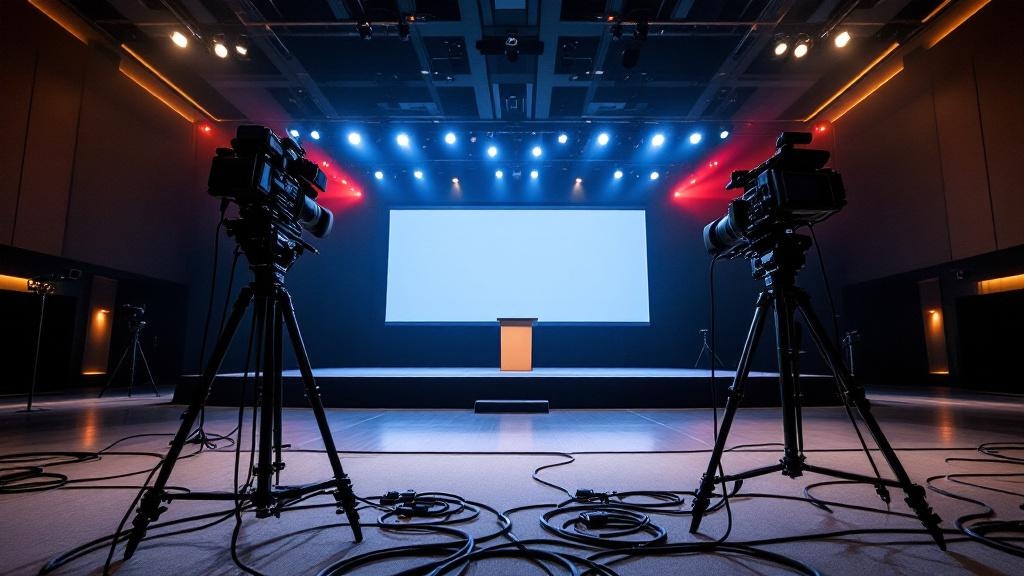
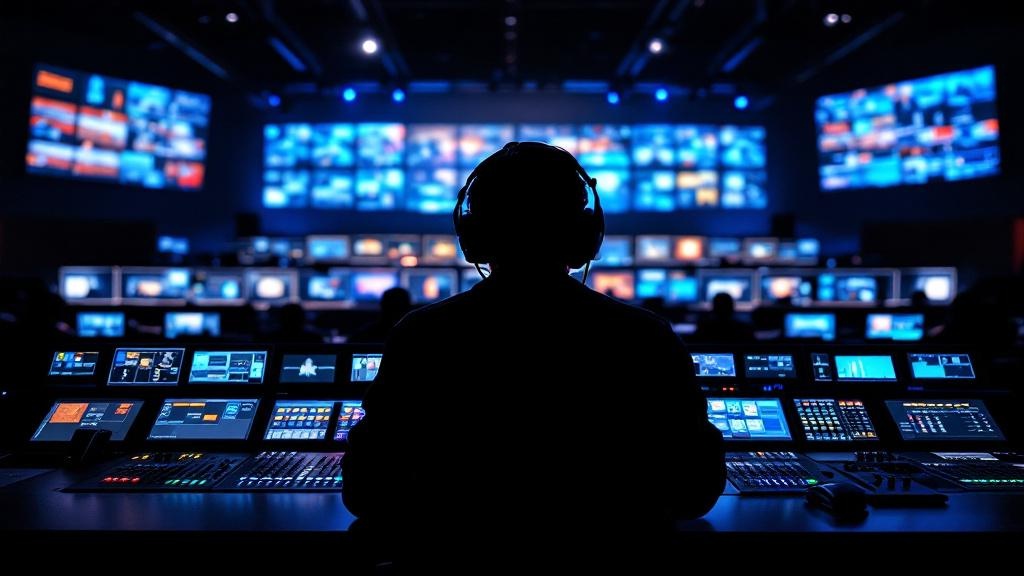
Any conference stage with more than one speaker requires multi-camera coverage. A standard setup for a panel discussion uses three to four cameras — a wide shot covering all panelists, individual tight shots on each active speaker, and a presentation or slide feed. A technical director switches between these feeds in real time using a production switcher such as a Blackmagic ATEM or Roland VR series. Without switching, remote viewers watch a static wide shot where facial expressions are invisible and engagement drops sharply.
Professional Audio Mixing
Audio is where most hybrid events fail first. A professional hybrid event av setup in Japan requires separate audio mixes: one for the in-room PA system and one for the streaming output. The room mix includes ambient reinforcement and may use delay speakers for large venues. The streaming mix is dry, compressed, and normalized for headphone listening. Running a single mix to both outputs guarantees either a poor room experience or a poor streaming experience.
Wireless lavalier microphones for each speaker are non-negotiable. Podium microphones pick up paper rustling, coughs, and inconsistent volume as speakers move. Ceiling-mounted array microphones can supplement but should never be the primary capture source for a produced stream.
Dedicated Internet
Venue Wi-Fi is shared, unpredictable, and architecturally unsuitable for upstream production traffic. Professional live event streaming services in Japan require a dedicated wired internet connection provisioned specifically for the stream. A 1080p stream at a stable bitrate demands a sustained upstream of at least 10 Mbps, and redundancy means provisioning twice that. Most major Tokyo conference venues — Tokyo International Forum, Makuhari Messe, Bellesalle — offer dedicated line provisioning, but it must be arranged weeks in advance and tested on-site before the event.
Redundancy Planning
Production-grade streaming requires backup systems for every critical path. This means a secondary encoder running in parallel, a backup internet connection from a different ISP or a bonded cellular failover, and an uninterruptible power supply (UPS) for core equipment. Japanese venues are required to meet stringent electrical and fire safety standards, but power interruptions during load-in or from tripped circuits remain a real-world risk that redundancy planning must address.
Platform Selection: Matching Technology to Audience
The streaming platform decision is an audience decision, not a technology preference. The right platform depends on where your viewers already are and what level of interaction the event requires.
| Audience Profile | Recommended Platforms | Key Consideration |
|---|---|---|
| International corporate | Zoom Webinar, Microsoft Teams Live Events, YouTube Live | Familiar UI for global attendees; strong API integrations for registration and analytics |
| Japan-domestic corporate | Zoom Webinar, V-CUBE, Cocripo | V-CUBE and Cocripo are established in Japanese enterprise environments with Japanese-language support |
| Japanese consumer or fan-driven | [LINE LIVE](https://www.jtbcom.co.jp/service/event/online/), Nico Nico Douga | LINE’s install base across Japan is unmatched; Nico Nico’s scrolling comment overlay drives real-time engagement in ways Western platforms do not replicate |
| Mixed international + Japanese | YouTube Live with bilingual moderation | Lowest barrier to entry across geographies; requires separate chat moderation in each language |
Hybrid Interaction Tools
The value of hybrid over one-directional streaming is audience interaction. Real-time Q&A, polling, and chat moderation must bridge in-room and remote participants without creating a two-tier experience. Tools like Slido, Mentimeter, or platform-native Q&A features should be tested with the specific streaming platform before event day. For bilingual events — common when providing technical support for hybrid events in Japan — chat moderation requires separate moderators for each language operating in real time.
Recording and On-Demand Replay
Every hybrid event should produce an on-demand replay asset. This means recording the program feed (not individual camera ISOs) at the highest quality the encoder supports, typically 1080p at a minimum. Post-event distribution — whether through a gated landing page, YouTube, or an internal portal — extends the event’s lifespan and contributes directly to lead generation and content marketing objectives. Recording infrastructure should be confirmed and tested during rehearsal, not assumed to be handled by the streaming platform’s built-in recording.
The Production Team You Need On-Site
Hybrid event production is a team operation. The instinct to minimize crew size by consolidating roles leads directly to the technical failures covered in the next section.
| Role | Responsibility | Why It Cannot Be Combined |
|---|---|---|
| Technical Director (TD) | Manages camera switching, calls shots, monitors program output | Requires constant visual attention on the multiview monitor; cannot simultaneously troubleshoot encoder issues |
| Streaming Engineer | Monitors encoder health, bitrate stability, platform dashboard, chat for viewer-reported issues | Must respond to streaming-specific problems in seconds; a TD watching cameras will miss encoder warnings |
| AV Crew (1–3 persons) | Lighting setup, sound reinforcement, stage management, camera operation | Physical tasks — adjusting lights, repositioning mics, managing presenter transitions — require hands on equipment |
| On-Site Coordinator | Manages event schedule, speaker logistics, liaison with venue staff | Ensures human logistics run parallel to technical execution without either blocking the other |
Why a Single Freelance Videographer Is Not Enough
A skilled freelance videographer can produce excellent documentary or promotional video. Hybrid event production is a different discipline. It requires simultaneous management of multiple live camera feeds, real-time audio mixing, encoder monitoring, platform management, and contingency response — all happening at once during a live broadcast with no opportunity for retakes. A single operator cannot switch cameras, adjust audio levels, monitor the stream health dashboard, and respond to a dropped internet connection simultaneously. The cost savings from a one-person crew are immediately erased by the first technical failure visible to your remote audience.
Common Technical Failures and How to Prevent Them

Most hybrid event failures are predictable and preventable. They recur because organizers underestimate the technical complexity of simultaneously serving two audiences — one in the room and one on a screen.
Audio Feedback Loops
When a presenter’s microphone picks up audio from the room’s PA speakers, the result is a feedback loop — a sharp, escalating tone that disrupts both in-room and remote audiences. In hybrid events, the risk compounds because remote participants on speakerphone during Q&A sessions can create secondary feedback paths through the streaming platform. Prevention requires separate monitor mixes, directional microphone placement, and strict muting protocols for remote participant audio during in-room segments.
Latency Mismatches During Q&A
Live streams carry inherent latency — typically 5 to 30 seconds depending on the platform and protocol. When an in-room moderator asks a remote participant a question, the remote viewer hears the question seconds after it is asked, and their response arrives seconds after they speak. Without managing this delay — through moderator coaching, buffer pauses, and pre-positioned questions — the Q&A session becomes stilted and confusing for both audiences.
Power Supply Failures
Event AV equipment draws substantial power. A standard hybrid production setup — cameras, switcher, encoders, monitors, audio console, lighting — can pull 3,000 to 5,000 watts. Older venues or non-purpose-built event spaces may have insufficient circuit capacity, leading to tripped breakers during the event. Prevention requires an advance venue electrical capacity assessment, dedicated circuits for production equipment, and UPS units on critical-path devices.
Fire Safety Compliance
Additional cables, temporary infrastructure, and equipment placed in event spaces are subject to Japan’s fire prevention regulations. The Fire and Disaster Management Agency requires that all temporary materials meet flame-retardant standards, and local fire departments conduct inspections during both setup and event periods. Cable runs must not obstruct emergency exits, temporary structures above 3.0 meters require pre-approval, and fire extinguishing equipment may be mandated for enclosed production areas. Non-compliance can result in shutdown orders — not fines, but immediate halts to the event. Organizers who book venues 6 to 12 months in advance should incorporate fire safety documentation into the early planning timeline, not treat it as a final checkbox.
Measuring Hybrid Event Success Beyond Attendance Numbers
Headcount — whether in-room or remote — is the least useful metric for evaluating a hybrid event. The metrics that matter are engagement depth, content afterlife, and cost efficiency.
Remote Viewer Engagement
The data available from streaming platforms is substantially richer than physical attendance counts. Key metrics include average watch time (how long did viewers actually stay?), peak concurrent viewers (when was the content most compelling?), interaction rate (what percentage submitted questions, voted in polls, or engaged in chat?), and drop-off points (where did the stream lose viewers?). A 500-person remote audience with an 85% average watch time and a 20% interaction rate delivered far more value than 2,000 registrants of whom 300 actually watched.
Post-Event Content Performance
The recorded replay is a standalone content asset. Measuring its performance — replay views within 7 and 30 days, social shares, email click-through rates to the replay page, and leads generated from gated replay access — quantifies the event’s long-tail value. Events designed with replay distribution in mind during production (clean program recordings, chapter markers, extracted highlight clips) generate significantly more post-event value than events where recording was an afterthought.
Cost-Per-Attendee: Hybrid vs. In-Person-Only
Hybrid events carry higher production costs than in-person-only events. The additional streaming infrastructure, dedicated internet, production crew, and platform fees add 20–40% to the technical budget. But the denominator changes. When a 200-person in-room event adds 800 remote viewers, the cost-per-attendee drops substantially — even after accounting for the hybrid premium. According to industry analysis of the global event and exhibition market, hybrid delivery models consistently demonstrate superior cost-per-attendee ratios compared to physical-only formats, which is a primary driver of their adoption as a business standard. For organizations hosting annual conferences or recurring executive briefings, the cumulative savings compound each cycle.
| Model | Typical Audience | Production Cost Index | Cost-Per-Attendee Index |
|---|---|---|---|
| In-person only | 200 | 1.0× | 1.0× |
| Hybrid (in-person + remote) | 200 + 800 | 1.3× | 0.26× |
| Virtual only | 1,000 | 0.6× | 0.12× |
The hybrid model does not replace in-person events. It makes them financially defensible by distributing production investment across a larger audience while preserving the in-room experience that drives relationship-building and high-value interactions.
Hybrid events done right expand your audience without compromising production quality — but the technical margin for error is razor-thin. DMPJ’s live streaming and hybrid event solutions handle professional AV setup, live streaming infrastructure, and hybrid event coordination so your team can focus on content and engagement. Explore our technical support for hybrid events in Japan to see what seamless technical execution looks like.
Sorry, the comment form is closed at this time.